How the Saudi Roshn League is changing its game on and off the pitch

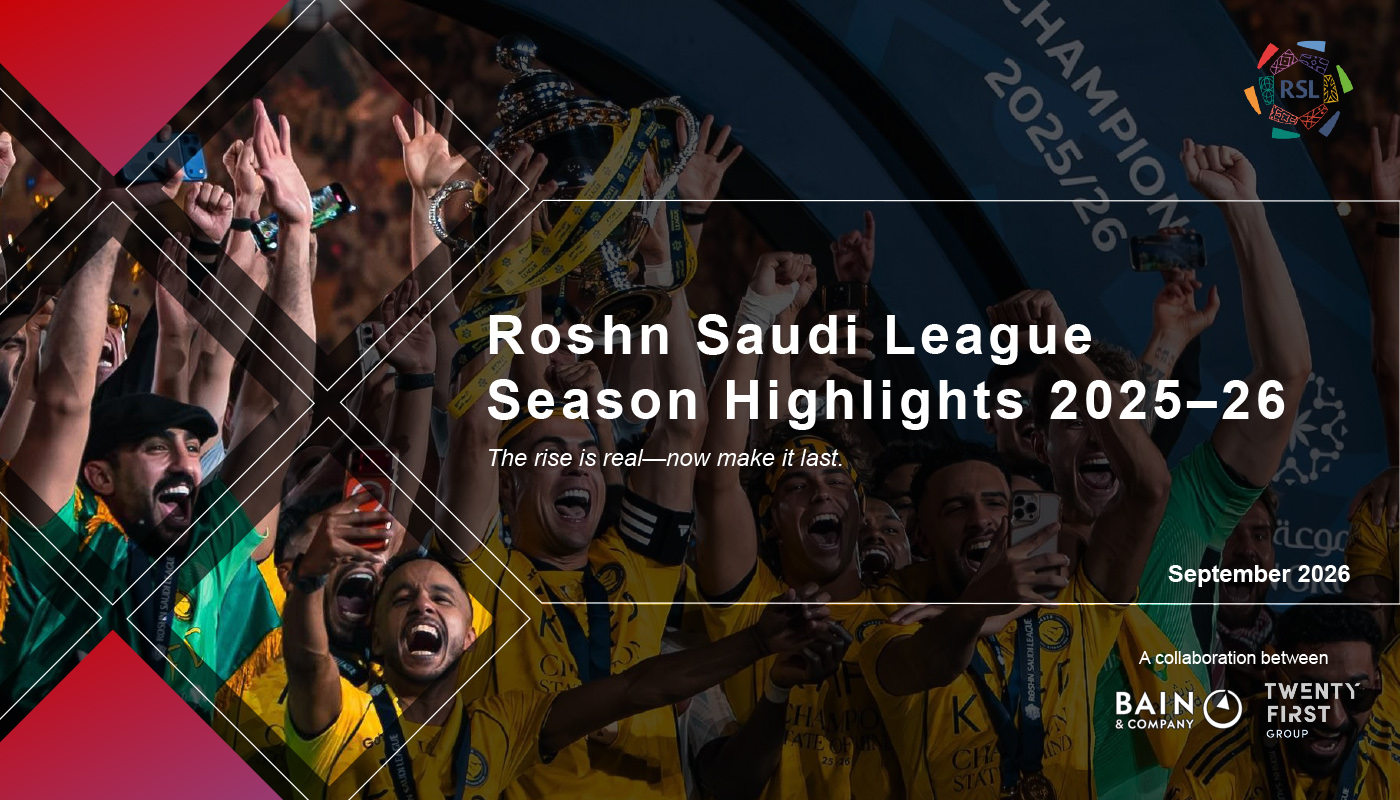
The Roshn Saudi League, Saudi Arabia’s premier football competition, has experienced remarkable growth over the past two years – both on and off the pitch. It has risen to become Asia’s second-highest-rated league, trailing only Japan’s J League, while closing its gap with Europe’s established competitions and steadily increasing its popularity among fans in the Kingdom and worldwide.
This progress comes from a comprehensive study by Bain & Company and Twenty First Group, who collaborated to analyse the league’s development and highlight areas for future growth. Their goal was to provide data-driven insights to league officials and club owners, sparking dialogue on how to take Saudi football to the next level.
While professional football in Saudi Arabia dates back to 1957, the current format of the Saudi Pro League was established in 2008. In 2022, the competition was renamed the Roshn Saudi League following a five-year sponsorship agreement with Roshn.
The 20-page analysis from Bain & Company and Twenty First Group showcases how far the league has come in a short time, focusing on the 2023/24 and 2024/25 seasons.
League Quality
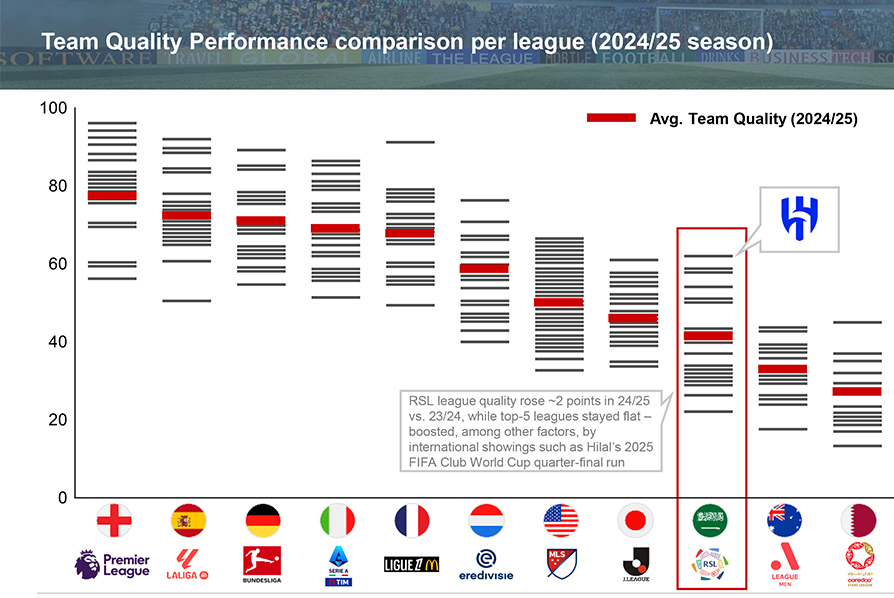
One of the key improvements highlighted is league quality, measured by factors such as the strength of individual squads, the level of competition, and how long the title race remains undecided. The average squad quality score has risen for two consecutive years, reaching 46 in the 2024/25 season. For context, a score of 100 represents the global benchmark, equivalent to a squad stronger than FC Barcelona or Champions League winners Paris Saint-Germain.
Competitiveness also improved. In 2024/25, the top teams finished with fewer points overall, and the gap between first and second place narrowed significantly – evidence of a tighter, more exciting title race. In a surprising twist, Al-Ittihad clinched the title despite only having the league’s third-best squad on paper, outpacing favourites like Al-Hilal.
For fans, long and unpredictable title races are essential to keeping the league exciting. For instance, Spain’s top flight has long been dominated by three clubs, which some fans find predictable, whereas in England, the unforgettable underdog story of Leicester City’s Premier League title win remains a highlight for many supporters.
Across the board, the Roshn Saudi League has climbed the Team Quality Performance Index developed by Bain & Company and Twenty First Group. It is now ranked second in Asia, behind Japan’s J League, and sits just behind the US Major League Soccer (MLS) globally.
That said, the Roshn Saudi League still has a clear quality gap between its top clubs – Al-Nassr, Al-Ittihad, and Al-Hilal – and the rest of the league. Addressing this imbalance will be key to sustaining competitiveness in the years ahead.
Team Value
The total value of players in the Roshn Saudi League rose significantly over the past season. Average player value increased by 35%, from $1.1 million at the start of the 2024/25 season to $1.6 million by its end, partly driven by high-profile acquisitions.
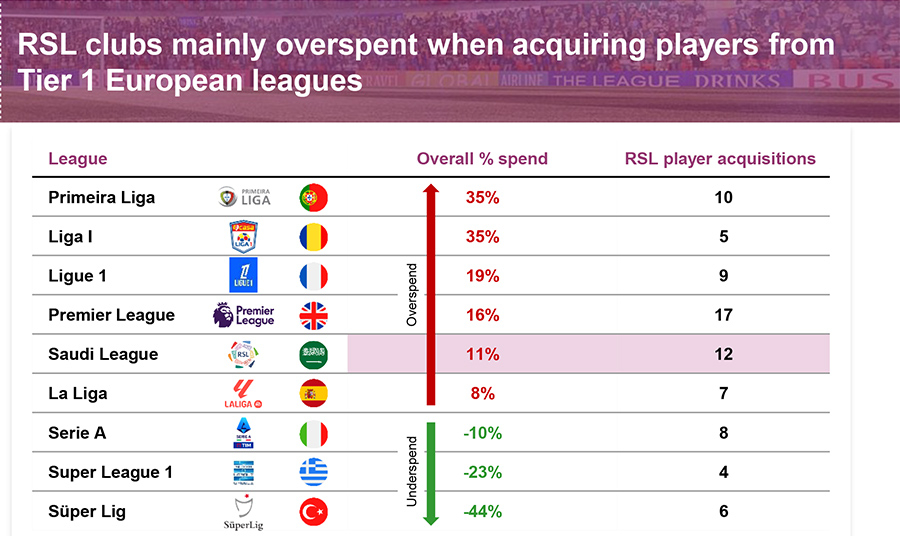
Some of the season’s biggest transfers included Al-Hilal signing Darwin Núñez from Liverpool for €53 million and Theo Hernández from AC Milan for €25 million. Al-Nassr secured João Félix from Chelsea for €30 million, while Al-Qadsiyah made headlines by purchasing Mateo Retegui from Atalanta for €68 million.
Despite these marquee deals, overall transfer efficiency improved compared to previous seasons. While Saudi clubs generally paid slightly below market value for most signings, they tended to overspend when recruiting from Europe’s top leagues, particularly the English Premier League and Portugal’s Primeira Liga.
Player Development
The report also highlights encouraging progress in player development. Saudi players accounted for 42% of total minutes played, a figure comparable to many top leagues worldwide.
Al-Wehda, Al-Khaleej, and Al-Raed were recognised for giving the most playing time to Saudi nationals, with around half of their total minutes played by local players. Youth development was particularly evident at Al-Qadsiyah and Al-Fateh, where under-23 players received 21% of total playing time, nearly double the league average.
However, overall participation for U23 players remains relatively low at 12%, well below the 18–23% typical of Europe’s top five leagues. Even so, this figure represents a noticeable improvement on last year’s numbers, indicating progress in nurturing young talent.
Fan Engagement
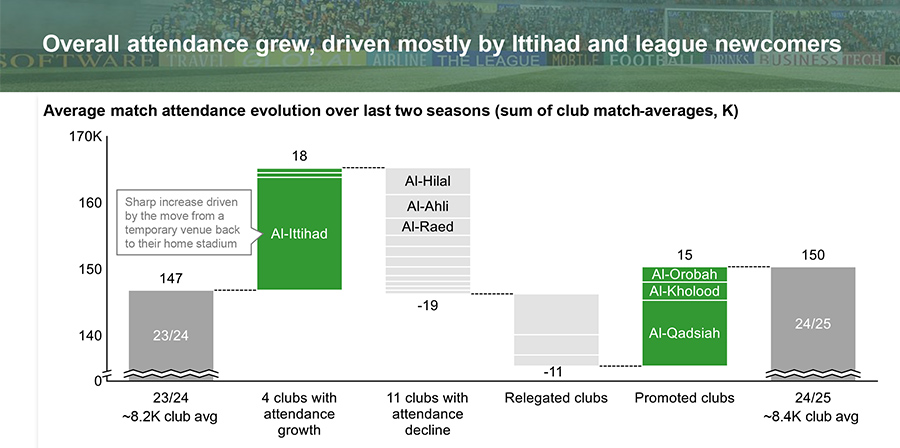
Fan engagement continues to grow in Saudi’s top football flight, both in stadiums and online. Average stadium attendance rose from 8,200 in 2023/24 to 8,400 last season, though utilisation rates remain well behind European leagues, where the Premier League for instance operates at 98% capacity. Al-Ittihad led the league in physical attendance, drawing nearly 35,000 fans per game and achieving 70% stadium utilisation.
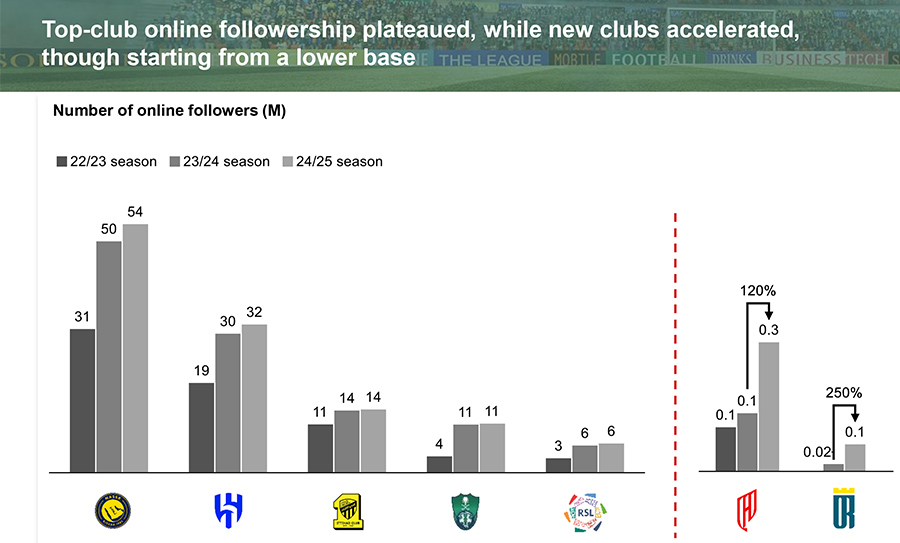
Digital engagement grew further, with the league’s overall online following growing by 5%. Al-Nassr boasts the largest digital footprint with 54 million online followers, while clubs such as Al-Qadsiyah and Al-Orobah saw dramatic increases in their fan bases, growing by 120% and 250% respectively.
The Next Level
“Saudi football is undergoing a profound transformation, with the league redefining itself through innovation and beginning to make its mark on the global stage,” said Jürg Kronenberg, EMEA Head of Bain & Company’s Sports practice.
Despite the progress, the report identifies several opportunities for further growth. These include improving transfer and salary spend efficiency, fostering a culture of youth development supported by investments in academies, expanding fan engagement, increasing stadium utilisation, and enhancing managerial and technical capabilities across clubs.
Kronenberg added, “By focusing on sustainable spending, nurturing young local talent, and creating world-class fan experiences, the Roshn Saudi League can become a global benchmark for football innovation and excellence.”
Blake Wooster, CEO of Twenty First Group, added, “The ambition and investment driving the Roshn Saudi League represent an unparalleled opportunity to shape not just the future of football in the region, but also to make a lasting impact on society as a whole.”