Middle East leads on AI sovereignty but must close the compute gap, Accenture finds

The Middle East has built an early lead in AI governance and sovereign cloud adoption, but the region must now push deeper into compute, models, and applications to turn that head start into lasting advantage, according to a report by Accenture.
Mapping the landscape for AI sovereignty in Saudi Arabia, Qatar, and the UAE, the report surveys nearly 2,000 business and government leaders across 28 countries, with a focused sample of 185 respondents from the United Arab Emirates, Saudi Arabia, and Qatar.
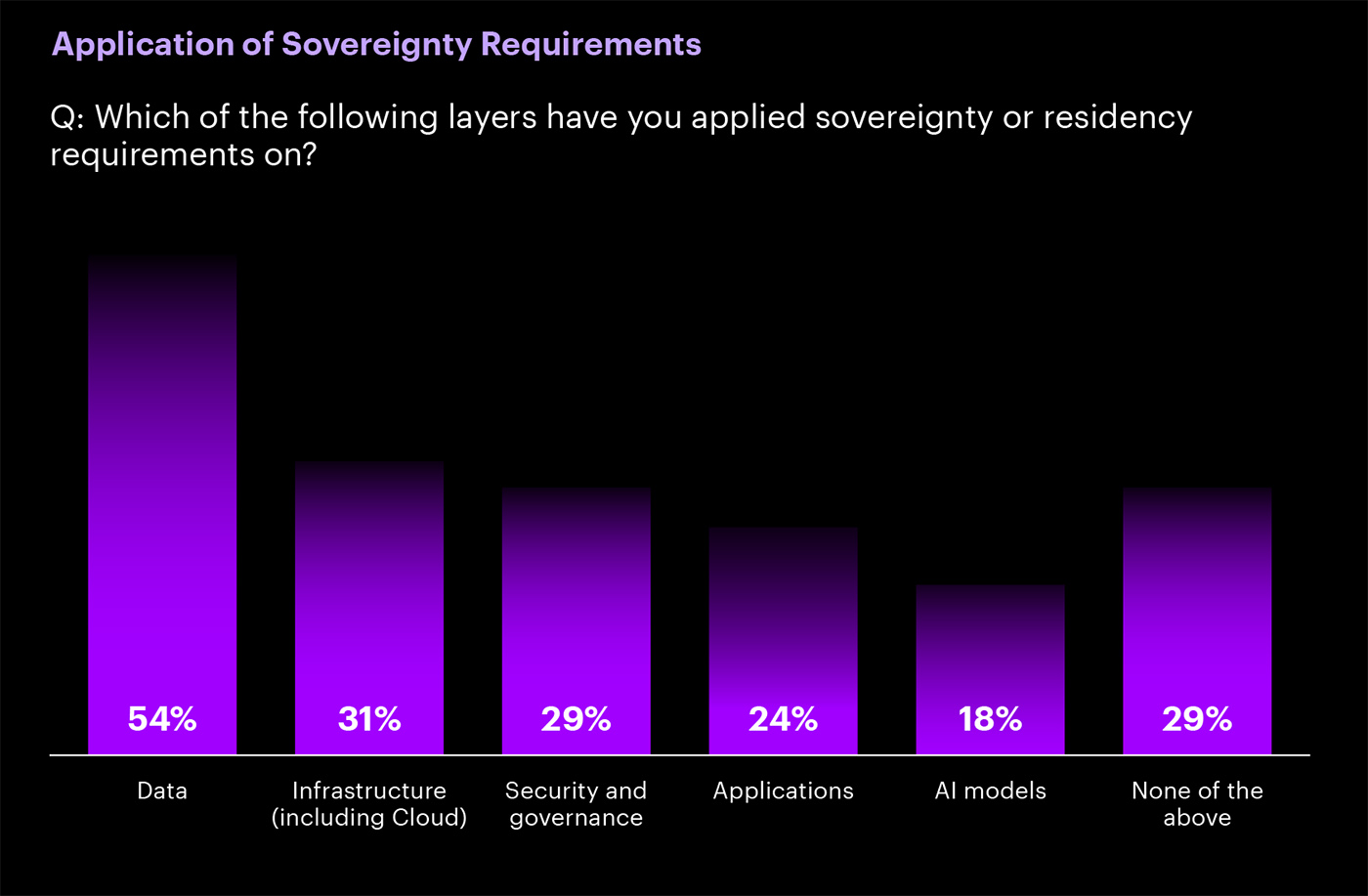
Data is a major priority: The survey found 54% of Middle East organizations have prioritized sovereignty or residency requirements on the data layer first, followed by infrastructure at 31%. This reveals that in the path to maturity, many organizations have managed to secure the regulatory core of their sovereignty, but now need to shift the focus to operational control.
“According to our research, adoption of generative AI alone could unlock more than $10.3 trillion in additional economic value by 2038 for organizations if generative AI is adopted responsibly and at scale, industry by industry, value chain by value chain,” said Abir Habbal, Middle East data and AI lead at Accenture and co-author of the report.
Strong on governance, behind on compute
According to the report, 60% of business executives in the Middle East describe their country’s approach to AI sovereignty as ‘highly sovereign’, compared with just 32% globally. 57% of data and workloads in the region have already shifted to sovereign cloud environments, versus 49% worldwide, and 65% of regional organizations say they are more likely to pursue sovereign solutions amid rising geopolitical tension.
Yet the report describes a widening gap between confidence and capability. Nearly two-thirds of respondents believe local sovereign AI solutions still lag global hyperscalers, and only 35% say sovereignty efforts meaningfully reduce their reliance on global providers.
“77% in the Middle East say governments, states or institutions have a key role to play in increasing digital and AI sovereignty – through regulation, subsidies or investments,” said Carla Maria Issa, Middle East research lead at Accenture and the report’s other co-author.
Compute remains the bottleneck
The report breaks sovereignty into five layers: Infrastructure, compute, models, applications, and data. It finds the region strongest in infrastructure, citing Saudi Arabia’s HUMAIN and its partnerships with Nvidia and AMD, alongside cloud providers such as G42 Cloud in the UAE and SCCC Alibaba Cloud in Saudi Arabia.
With its expanding urban centers and mega-projects, it is safe to say the GCC region’s ability to build big and fast is more than proven – and that extends to data centers and the power infrastructure needed to power them.
However, compute and inference remain the weakest layers. Saudi Arabia has secured orders for more than 18,000 advanced Nvidia AI chips, and the UAE has obtained licensed access to more than 20,000 Nvidia A100 and H-series chips, but the report notes that advanced chip design and manufacturing stay concentrated among a small group of global firms.
Model development is advancing through initiatives such as Saudi Arabia’s ALLAM, the UAE’s Falcon and Jais, and Qatar’s Fanar, all built around Arabic-language capability, though large-scale commercialization remains early-stage relative to global peers.
Leadership and talent
Perhaps the starkest finding concerns leadership. The report states that only 10% of organizations in the Middle East have made AI sovereignty a CEO or board-level concern, despite 77% of respondents believing governments play a critical role in advancing digital and AI sovereignty. Accenture calls this a critical blind spot, arguing that without executive ownership, sovereignty risks becoming a compliance exercise rather than a source of competitive differentiation.
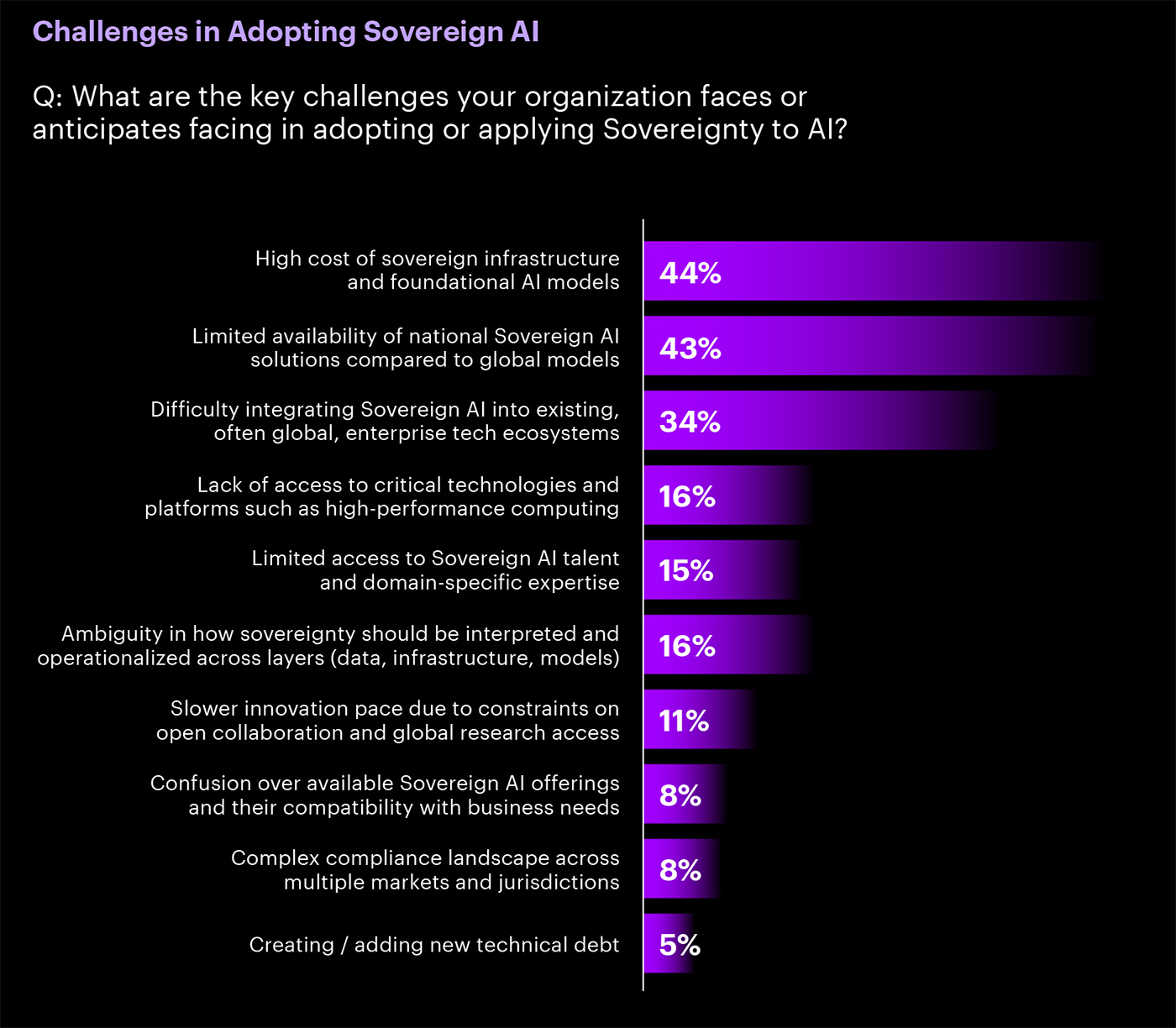
The co-authors also point to a talent shortfall, noting that limited access to sovereign AI talent ranks among the top challenges organizations face.
“With architecture and infrastructure foundations in place, organizations must turn to the human layer of the AI stack. Achieving Sovereign AI is not only a technical challenge – it is a talent imperative,” said Habbal.
“This means moving decisively from traditional workforce planning to a fully integrated, skills-based, human + AI talent strategy that aligns people, technology and business strategy from the outset.”
Five imperatives for the next phase
Accenture lays out five priorities: Putting sovereignty on the CEO and board agenda, reframing it as a driver of value rather than only risk management, building hybrid ecosystems that blend local trust with global scale, redesigning architecture for flexibility across infrastructure and models, and shifting toward an integrated human-plus-AI talent strategy.
The report cites the UAE’s GovGPT platform and reported discussions between OpenAI, the UAE government, and G42 over a localized version of ChatGPT as examples of sovereignty being used to create value rather than simply manage risk.
The report concludes that the region has built a strong foundation but sits at a turning point, and that what happens next will determine whether the Middle East shapes the AI economy on its own terms or operates within systems designed by others.
“The next phase will depend on closing capability gaps by improving the competitiveness of national AI platforms, reducing infrastructure costs and demonstrating measurable business and national value to power a sovereign AI economy,” noted Habbal.
“Strategic use of energy advantages will also be critical. By capitalizing on some of the world’s most cost-effective and secure power supplies, Middle Eastern nations structurally lower the cost of scaling sovereign compute. This not only reduces operational costs but also positions the region as a global hub for training and deploying advanced AI systems.”