Inadequate testing is derailing ERP transformations, finds Argon & Co report


Most enterprise resource planning projects fail to deliver on their promises, and the cause is rarely the software itself, according to a report from Argon & Co, a global management consultancy specializing in operations strategy and transformation.
Enterprise resource planning systems, commonly known as ERPs, are the software platforms that companies rely on to manage core operations such as finance, supply chain, procurement, and human resources in one connected system. Because so many critical business functions run through them, a poorly executed ERP transition can disrupt an entire organization, not just its technology department.
Companies across Saudi Arabia, the UAE, and the wider Middle East are rushing into system overhauls without adequately testing whether their businesses can actually operate on the new platforms before switching them on.
A confidence problem, not a coding problem
Organizations across the region are moving away from aging, customized ERP systems toward modern platforms like SAP S/4HANA, Oracle Cloud ERP, and Microsoft Dynamics 365, the report says. These transitions are meant to standardize processes, improve data quality, and enable automation and AI. But this shift is far more complicated than swapping one system for another, since process redesign, data migration, outside integrations, regulatory rules, and user adoption all have to work together at once.
Around 75% of ERP initiatives fail to fully achieve their intended business outcomes, according to Gartner. A separate study by McKinsey and the University of Oxford found that large IT programs run 45% over budget on average while delivering 56% less value than planned. The Consortium for Information and Software Quality estimated the cost of poor software quality to the US economy at roughly $2.41 trillion.
Taken together, these numbers suggest that failure may be more the norm than the exception, and that it likely stems less from technical issues than from a lack of proof that a business can run smoothly on a new system.
How trust erodes over time
The Argon & Co report describes a chain reaction it calls the ‘confidence erosion’ cycle. It typically starts when testing is pushed to the end of a project rather than built in from the start, which works to hide integration problems. Data quality issues then undermine the results of whatever testing does happen.
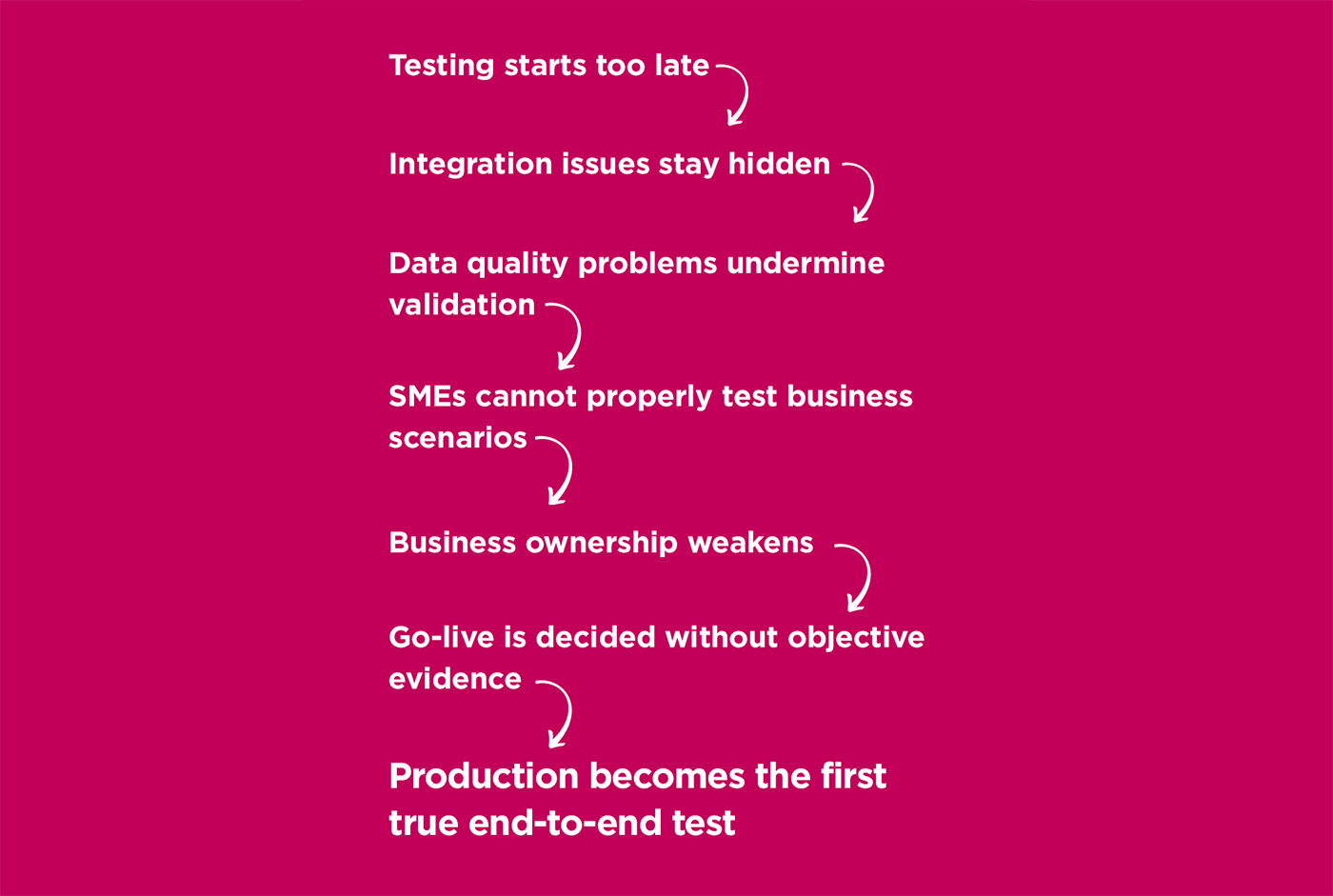
By the time employees get access to the system during user acceptance testing, they are often encountering it for the first time rather than confirming something already proven, and oversight of the outcome quietly shifts back to the technology team. Eventually, the decision to launch is made based on status updates and optimism rather than solid evidence that everything works smoothly.
The consequences of that pattern have played out publicly. The report points to Birmingham City Council in the United Kingdom, which launched an Oracle system with a pre-launch testing process that was later described by auditors as inadequate. After a series of setbacks, the local government’s budget for the project ballooned from an estimated £19 million toward more than £200 million, and the council eventually declared a form of financial insolvency.
It also cites Zimmer Biomet, a medical device manufacturer that filed a $172 million claim against its implementation partner after a 2024 system launch left the company barely able to ship products or generate basic invoices, according to the report. Clearly, these are horror stories, but they highlight the needs for good implementation strategies.
“Testing failures do not stay technical. They become business failures, measured in disrupted operations and material financial loss,” said Stefan Westdijk, managing partner at Argon & Co.
Recommendations and the role of AI
To address the problem, Argon & Co recommends what it calls the ‘ASSURE’ operating model, which calls on leaders to: Align testing with real business outcomes; start validation early in a project rather than at the end; treat data quality as a foundation to be proven; test processes end-to-end instead of function by function; set objective criteria for launch decisions; and give business leaders direct ownership over acceptance and the authority to delay a release.
The report also highlights how AI is reshaping ERP testing, noting that according to Capgemini’s World Quality Report for 2026, 89% of organizations are either piloting or already using AI-enabled quality engineering tools to generate test scenarios, flag high-risk processes, and surface problems earlier. Still, the report cautions that AI cannot replace human judgment on whether a process is genuinely acceptable for a business to run on.
A previous whitepaper from Argon & Co explored how AI and ERP transformation success depends less on the technology itself and more on the operating model surrounding it, finding that fewer than half of ERP programs achieve or exceed their intended business outcomes. That report argued organizations should replace siloed departmental structures with cross-functional teams built around business outcomes.
“The organizations that deliver successful ERP transformations are not those that build fastest. They are those that establish confidence before they commit to go-live,” Westdijk said.