UAE leads the Gulf in electric driving readiness as focus shifts beyond the vehicle

The competitive edge in electric vehicle adoption is no longer determined by the vehicle itself, but increasingly by the infrastructure and ecosystem. That is according to Global Electric Mobility Readiness Index (GEMRIX) 2026 from Arthur D. Little, which ranks the UAE as the top-performing country in the Gulf and China as the global leader.
The ecosystem surrounding electrical vehicles, rather than the technology inside them, is now the decisive factor separating markets that are pulling ahead from those that are falling behind, the report found.
The third edition of GEMRIX, described as the most comprehensive study of its kind, assessed 31 markets across five dimensions: Macro factors, electrical vehicle (EV) market and competition, customer readiness, public charging infrastructure, and total cost of ownership and regulation. A score of 100 signals that a market has reached parity between electrical vehicles and traditional combustion vehicles.
China and Norway lead a small pack
Only two markets have moved past that parity line. China, with a score of 106, and Norway, at 103, are the sole countries to exceed 100 on the index. While Norway has long led the way in EV sales, China is now the world’s top manufacturer, with an increasingly large number of EVs on the road.
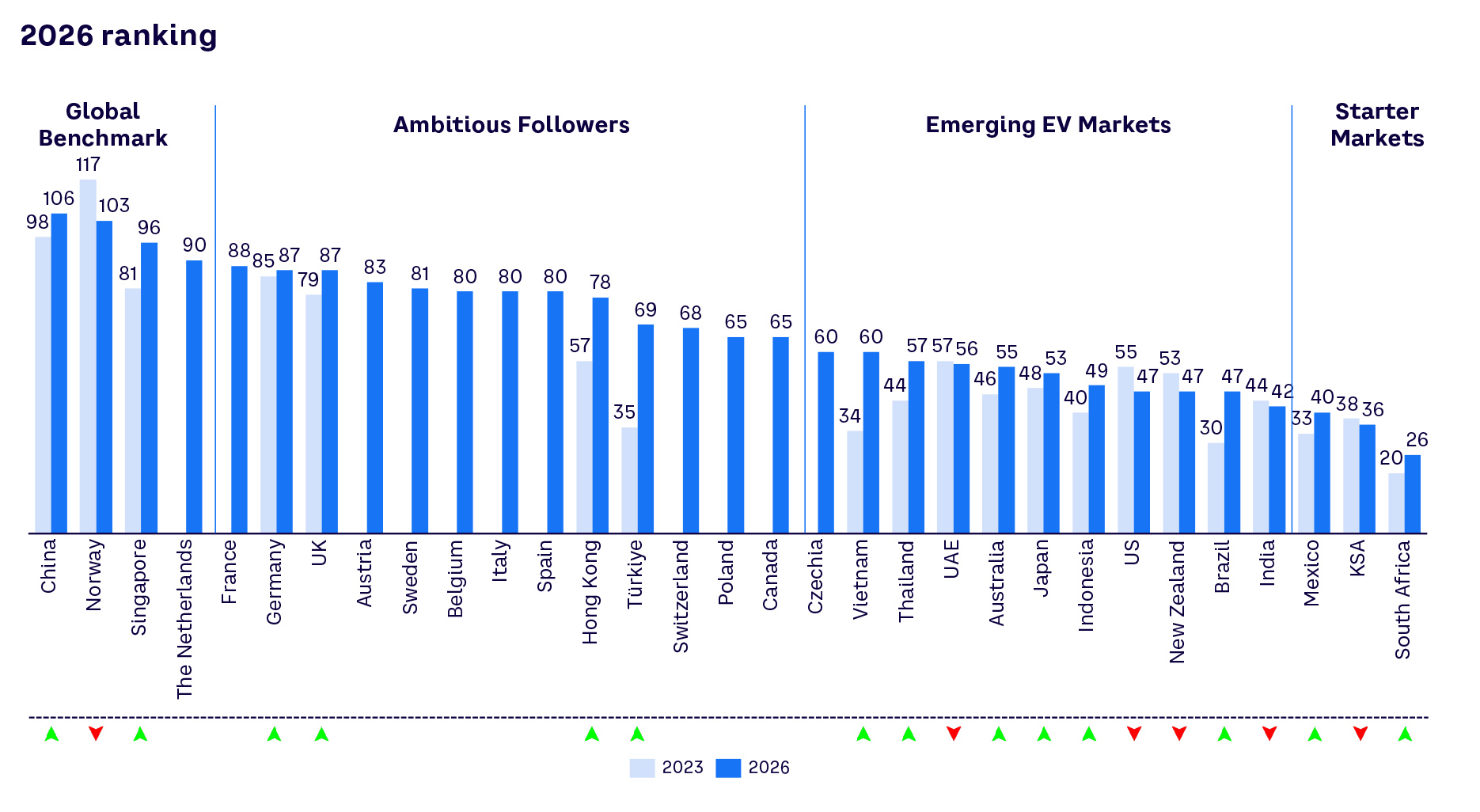
Singapore, at 96, and the Netherlands, at 90, follow close behind. According to the report, sustained EV adoption in these markets stems from aligned conditions across the entire ecosystem rather than any single policy or product breakthrough.
The report also points to a broader, more fragmented picture beyond the leading group. The transition, it says, has become multi-speed and multi-pathway. Growth has accelerated in Europe, while Turkey, Thailand, Vietnam, Indonesia, and Brazil are advancing through their own mixes of affordability, infrastructure investment, industrial policy, and local manufacturing champions.
Battery electric vehicles (BEV) are not expected to scale at the same rate everywhere, and in several markets, plug-in hybrids (PHEV) and range-extended electric vehicles continue to serve as a bridge technology.
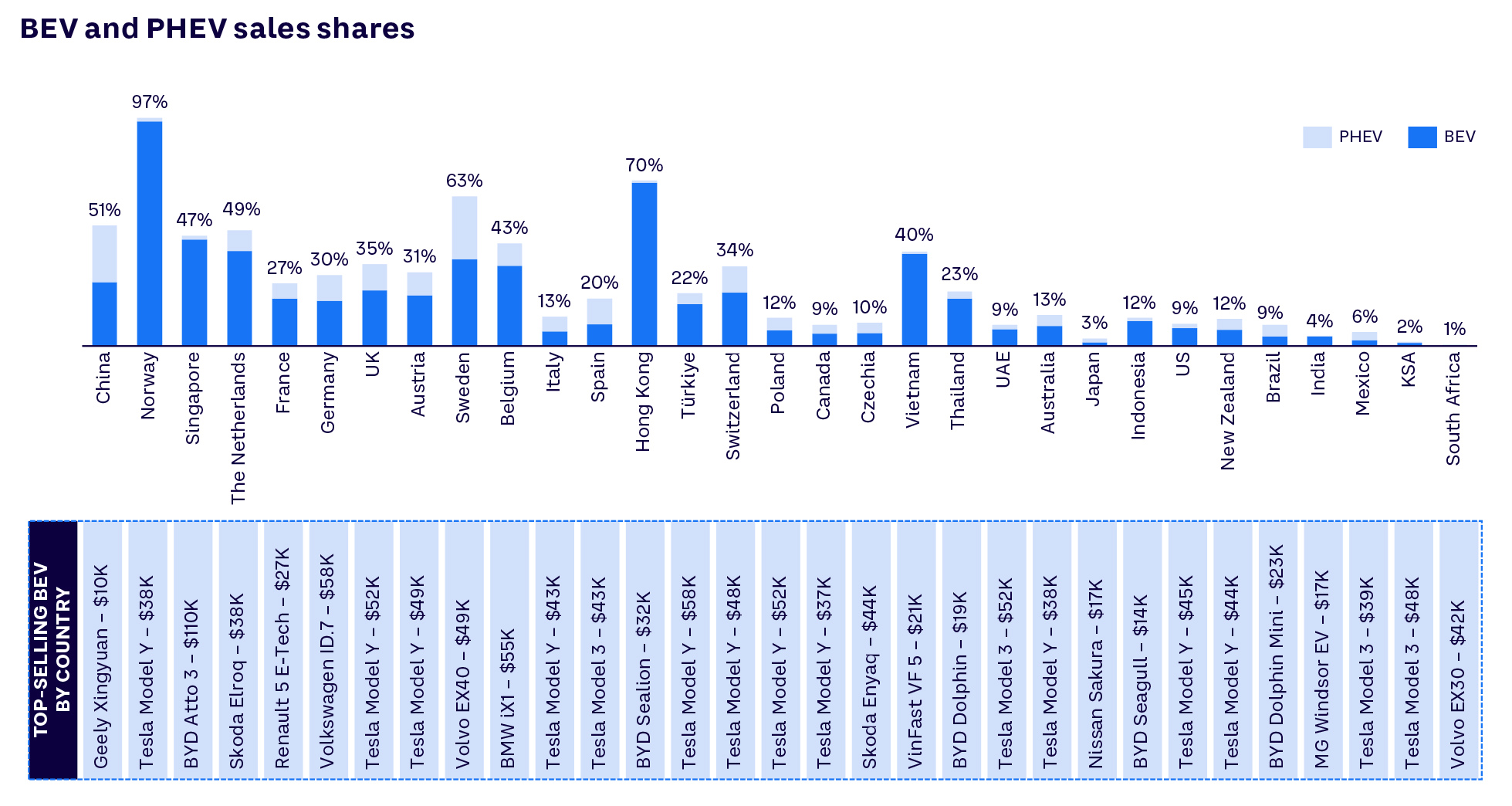
Another major theme in the report concerns where competitiveness is actually being built. China, the report argues, has set the global benchmark not through vehicle technology alone but by combining manufacturing scale, battery and component supply chains, software-defined vehicle capabilities, charging rollout, energy economics, incentives, and regulation into a single, coordinated system.
The expansion of Chinese automakers into emerging markets, the report notes, demonstrates how ecosystem fit, affordability, and speed can outweigh the advantages long held by established brands. For example, the top-selling BEV in Thailand is the BYD Dolphin, while in Brazil and Indonesia it is the Dolphin Mini, also known as the Seagull (an alternative name in certain markets).
UAE tops the Gulf, but gaps remain
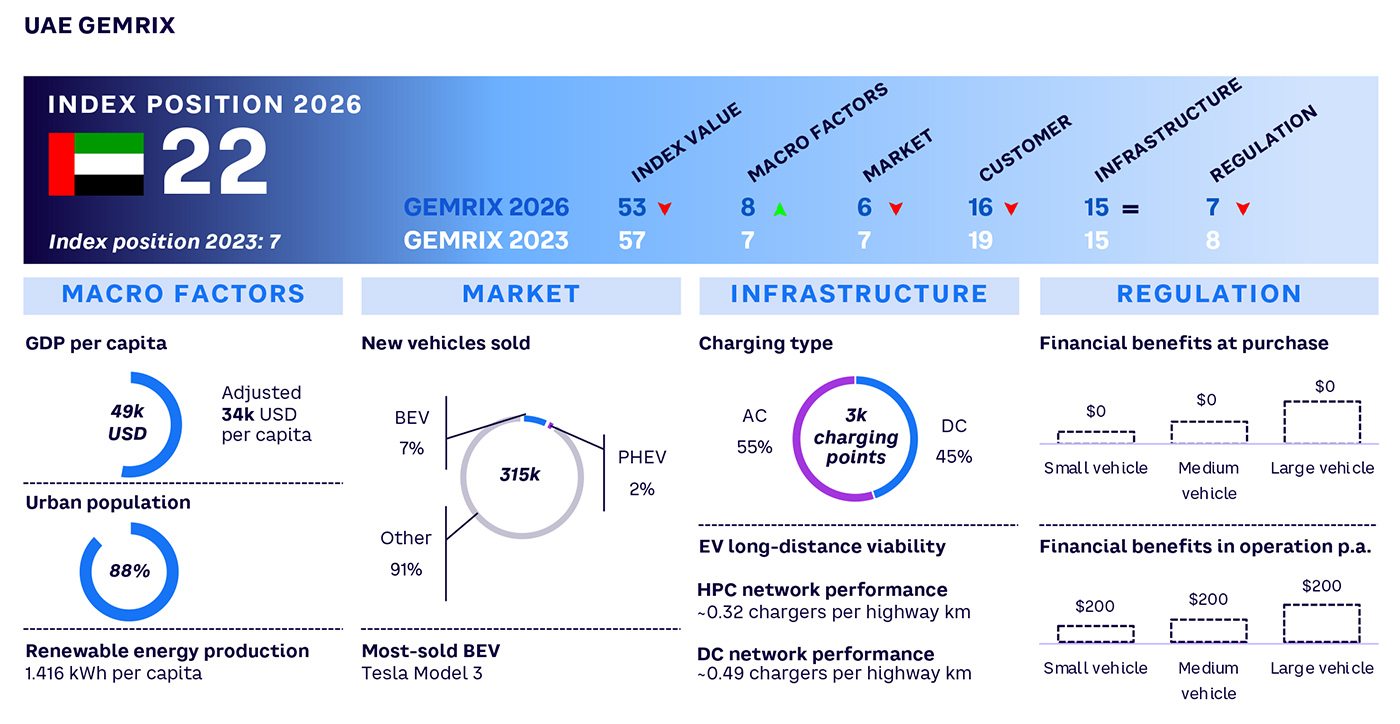
Among Gulf markets, the UAE ranks highest, placing 22nd globally out of the 31 markets studied, with a score of 53. That makes it the top-performing market in the GCC’, though still well below the parity threshold reached by the leading nations. The report noted the UAE among other developing nations with an EV market that is growing, but not yet fully embedded.
EVs accounted for roughly 9% of new vehicle sales in the UAE in 2025, the report found, with battery electric vehicles making up an estimated 6% to 8% of that figure and plug-in hybrids contributing around 2.5%. Charging infrastructure in the country has grown to approximately 2,800 charging points nationwide, including around 1,250 DC fast-charging points and 350 high-power charging units.
The UAE has also set longer-term targets for its mobility transition. The country aims to have 50% of vehicles on its roads be electric or hybrid by 2050, while Dubai has set a nearer-term goal of exceeding 15% EV share within its vehicle fleet by 2030.
“The UAE’s position in GEMRIX 2026 reflects an EV market with growing visibility and a clear ecosystem direction,” said Joseph Salem, partner at Arthur D. Little.
“EV adoption is gaining momentum alongside continued investment in charging infrastructure and strong long-term mobility ambitions. The opportunity now is to keep aligning infrastructure, vehicle availability and customer needs to translate this momentum into broader market scale.”
Further reading: Sustainable mobility a $400 billion opportunity for GCC.
An ecosystem race, not a technology race
Taken together, the findings from Arthur D. Little suggest that the next phase of the global EV transition will be defined less by advances in the vehicles themselves and more by how effectively countries coordinate infrastructure, supply chains, incentives, and regulation.
For Gulf markets, and the UAE in particular, that framing suggests that continued investment in charging networks and supporting policy will matter as much as consumer demand in closing the gap with global leaders such as China and Norway.
“The EV race is no longer just about vehicle technology,” said Philipp Seidel, principal at Arthur D. Little.
“Chinese success shows what happens when product, manufacturing and supply chains, infrastructure, energy and policy are orchestrated as one system. Thanks to this, Chinese OEMs now increasingly dominate the global market through targeted export of not only vehicles but of full EV ecosystems.”