How agentic AI is transforming the operating model of organizations

Agentic AI is the next major shift in enterprise operations. Unlike traditional automation or AI copilots, agentic AI systems can interpret intent, plan multi-step work, use tools, collaborate with humans and other agents, and learn from outcomes. This changes not just productivity, but the operating model itself, writes Ghasan Aldahan from Elm.
For executives, the strategic implication of agentic AI is is clear: organizations are moving from human-centric operating models to human-AI operating models where AI agents increasingly execute operational work while humans focus on judgment, strategy, relationships, and exception handling. The winners will not simply add AI tools. They will redesign around outcomes, orchestration, and governance.
Sustainable adoption, however, depends not only on deploying agents but on building the internal organizational capabilities required to design, govern, supervise, and continuously improve agent-enabled operations over time. This shift should also be approached as a phased transformation, with clear value realization, strong governance, cost discipline, and deliberate workforce development to ensure that agentic AI strengthens institutional capability rather than weakening core human skills.
From Automation to Autonomous Operations
Enterprise work has evolved through clear stages: Manual work à Digitization à Automation à AI-assisted work à Agentic AI-driven operations.
Traditional automation handles predefined tasks. Copilots help humans work faster. Agentic AI goes further: it can pursue goals, make context-aware decisions, and adapt in real time. That makes it fundamentally different from RPA, predictive AI, and even generative AI copilots.
The practical result is a new operating pattern: instead of employees doing all the work and systems supporting them, organizations increasingly have people orchestrating AI agents that perform parts of the work end-to-end.

Why Traditional Operating Models Are Under Pressure
Most operating models were designed for a world where:
- decisions had to be made by humans,
- coordination required meetings and handoffs,
- processes were fixed and sequential,
- managers supervised people, not systems,
- and organizational structure followed function, not outcome.
Agentic AI breaks those assumptions. If AI can monitor data, generate options, execute actions, and escalate only when necessary, then many classic management layers become bottlenecks rather than enablers. The issue is no longer only whether work can be automated; it is whether the organization can absorb autonomous execution at scale while maintaining accountability, workforce capability, and cost control.
What Changes in the Operating Model
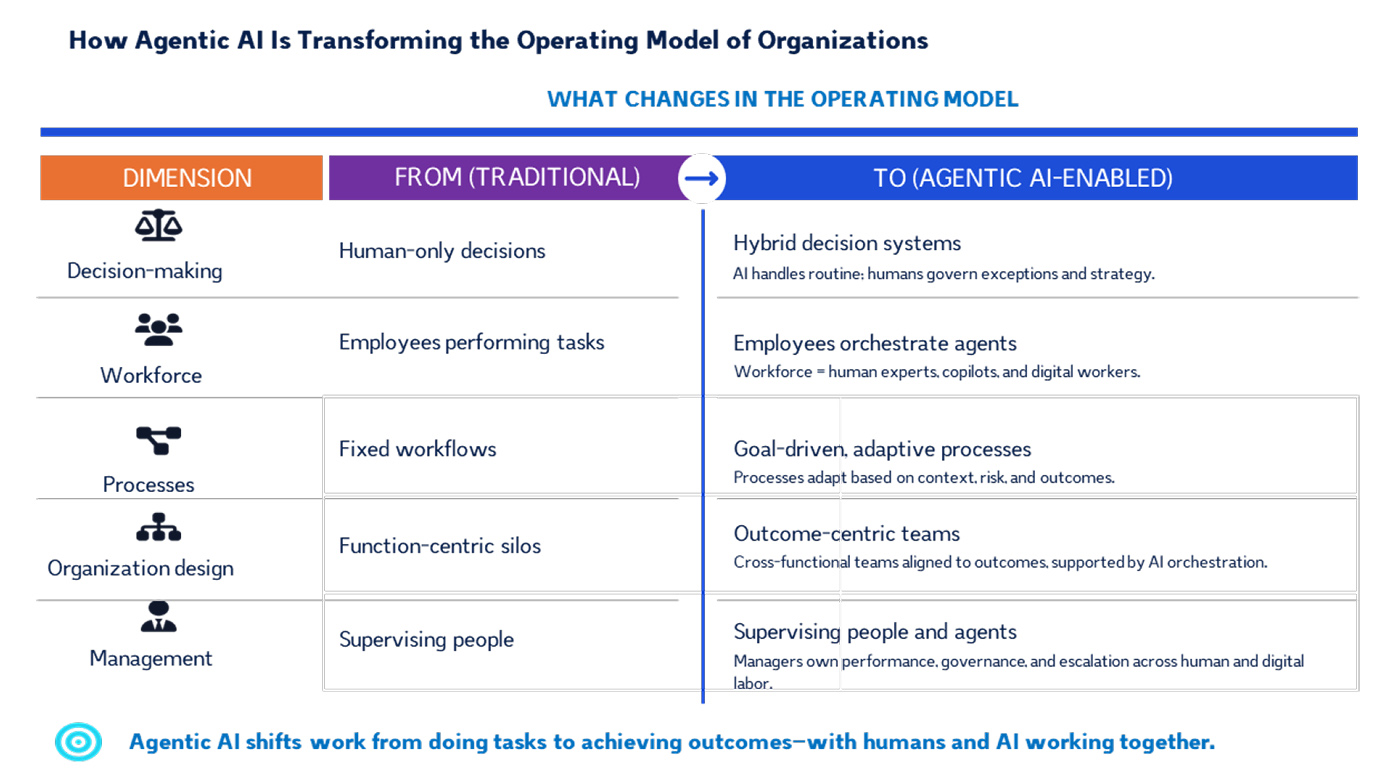
An overview of the five changes that will take place in the operating model:
Decision-making
From human-only decisions to hybrid decision systems where AI handles routine operational choices and humans govern exceptions and strategic trade-offs.
Workforce
From employees performing tasks to employees orchestrating agents. The workforce becomes a mix of human experts, copilots, and specialized digital workers. Organizations must ensure employees do not become passive recipients of AI output, but continue to build the judgment and foundational skills needed to validate, challenge, and improve agent-generated work.
Processes
From fixed workflows to goal-driven, adaptive processes that can adjust based on context, risk, and outcomes.
Organization design
From function-centric silos to outcome-centric teams supported by AI orchestration.
Management
From supervising people to supervising people and agents. Managers increasingly own performance, governance, and escalation across both human and digital labor.
What the Future Operating Model Looks Like
A practical agentic operating model has six layers:
- Business outcomes
- Human leadership and expertise
- AI copilots
- Specialized AI agents
- Multi-agent orchestration
- Governance, risk, and control
In this model, humans set direction and guardrails, copilots support individual productivity, agents execute defined work, orchestration platforms coordinate activity, and governance ensures compliance, auditability, and accountability.
The evolution toward AI-first operating models highlights a key trend: reusable agent patterns, telemetry, governance, and cross-domain orchestration are becoming foundational capabilities for modern enterprises.
Industry Examples
Across industries, agentic AI is reshaping how organizations manage workflows, respond to disruptions, and deliver services – from government and healthcare to logistics and manufacturing.
Government Agencies
- Current model: Slow, manual, and fragmented workflows across procurement, benefits, compliance, and service delivery.
- Agentic model: AI agents route cases, check documents, monitor compliance, and trigger next steps with human oversight.
- Outcome: Faster service, lower administrative burden, better compliance, and more capacity for staff to focus on complex cases and public outcomes.
Logistics
- Current model: Fragmented data across TMS, WMS, ERP, and partners; planners rework routes and capacity manually; limited real-time visibility leads to delays, penalties, and unhappy customers.
- Agentic model: AI agents monitor shipments end-to-end, detect disruptions, re-plan routes and capacity within cost/service thresholds, generate documentation, and proactively inform customers of ETAs and exceptions.
- Outcome: Lower costs, higher on-time performance, more resilient networks, and a better customer experience, with human experts focusing on complex decisions and key relationships instead of firefighting.
Healthcare
- Current model: clinician time is consumed by documentation and coordination.
- Agentic model: agents manage scheduling, documentation, referrals, and patient follow-up.
- Outcome: less administrative burden, better patient flow, improved experience.
Manufacturing
- Current model: periodic planning, manual exception handling, reactive maintenance.
- Agentic model: agents optimize maintenance, production scheduling, and supply chain responses.
- Outcome: less downtime, more resilience, faster recovery from disruption.
The New Leadership Challenges
Agentic AI creates real value, but it also changes the risk profile. Leaders must address:
- Governance: Who authorizes autonomous action?
- Accountability: Who owns agent decisions and failures?
- Compliance: How are regulatory requirements enforced?
- Transparency: Can the organization explain what agents are doing?
- Workforce impact: Which roles change, disappear, or expand?
- Trust: Will employees and customers rely on the system?
- Resistance: How do you prevent fear from slowing adoption?
These are not technology questions alone. They are operating-model questions. They must also address cost control across models, orchestration, monitoring, and human oversight; the sustainability of internal capabilities required to supervise and improve agent-based work; and the risk of skill erosion if employees become overly dependent on AI for writing, analysis, and everyday digital productivity tasks.
Conclusion
Agentic AI is changing the logic of enterprise design. The organization of the future will not be built around humans doing all the work and software supporting them. It will be built around humans setting direction, AI agents executing more of the operation, and orchestration layers connecting the two.
That is why agentic AI is not merely a technology upgrade. It is a fundamental redesign of how organizations create value.