EY-Parthenon: CEOs prioritize portfolio optimization for growth and AI for productivity

Despite geopolitical uncertainty, slower macroeconomic growth and rapid technological change, CEOs remain firmly focused on creating their own path in terms of growth, efficiency and resilience. That is according to the latest CEO Outlook Survey from EY-Parthenon, which surveyed 1,200 CEOs across more than 20 countries.
The report from EY’s strategy consulting outfit found that AI is emerging as a source of productivity improvement for organizations, although many CEOs note the challenge of translating those gains into measurable business value.
Half of the CEOs surveyed worldwide identified AI technologies as the single largest contributor to productivity gains over the past 12 months, ahead of business process redesign (46%). Rather than treating these gains as a short-term efficiency win, 48% of respondents are reinvesting the additional capacity into innovation and transformation.
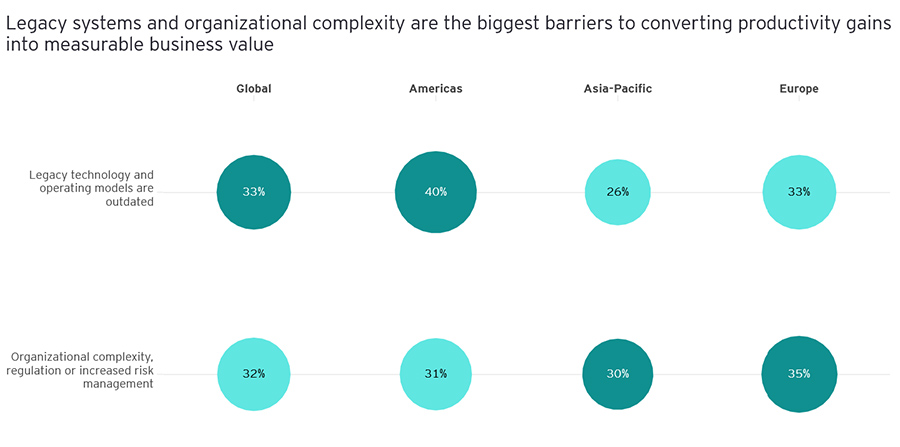
As AI adoption accelerates, attention is shifting from efficiency to value creation. While CEOs report tangible operational improvements from AI, many are struggling to translate those into meaningful growth and profitability. Legacy systems, organizational complexity and regulatory requirements continue to be limiting, with a fifth of leaders surveyed saying that AI-driven gains are often absorbed before they fully translate into bottom-line results.
The AI ROI challenge
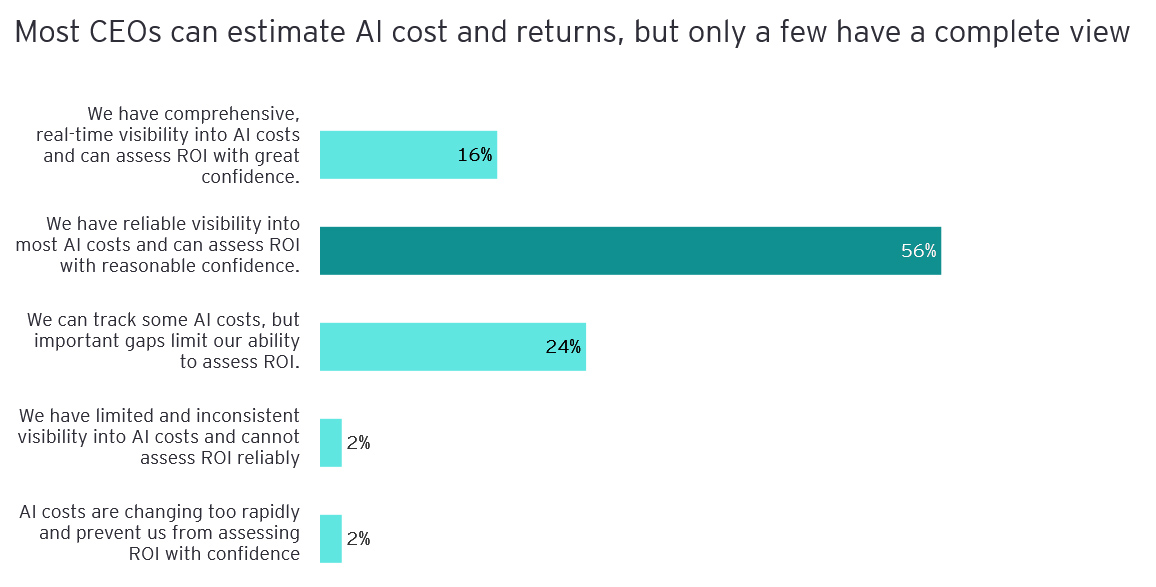
CEOs surveyed still struggle to measure and quantify the impact of AI investments. While more than half (56%) of respondents report at least some reliable visibility into AI costs and returns, only 16% of respondents shared they have clear, real-time visibility of ROI.
Around a quarter can track some AI costs but remain limited in their ability to assess overall ROI, highlighting an emerging gap between AI adoption and organizations’ capacity to measure value creation.
Sriram Changali, a partner at EY-Parthenon, said: “It is clear that AI is creating productivity gains; yet productivity is but a small part of the value that it can bring. Too often, CEOs and management teams deploy AI within individual functions rather than incorporate it into the end-to-end workflow, from production through to consumption, to create value for customers.”
“Hence, CEOs and boards need to identify AI-driven business models and value pools that drive growth; capturing those opportunities will require organizations to realign their operating models, talent and capital, turning AI from an efficiency tool into an engine for measurable value creation at scale.”
Further reading: Three-quarters of AI-linked gains captured by just 20% of companies.
Skills become the growth constraint
CEOs overwhelmingly see AI as a workforce transformation issue rather than a blunt instrument for changing headcount. An overwhelming majority (80%) believe that AI will have a greater impact on roles, skills and ways of working than on workforce size over the next three years.
Yet workforce readiness is emerging as a major concern. Nearly half (47%) of CEOs say their organizations are not developing AI skills quickly enough to keep pace with innovation. As well, 72% of respondents believe skills shortages will become a greater barrier to growth than access to capital within three years.
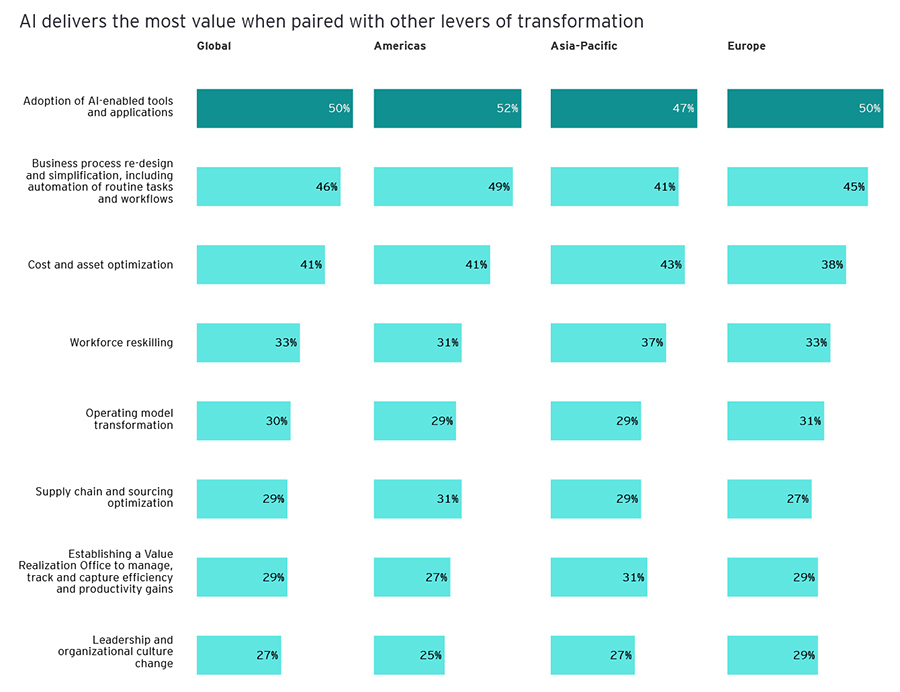
The findings suggest that while organizations are rapidly adopting AI, many are finding it harder to develop the skills and capabilities needed to realize its full potential. Reskilling is already a key driver of productivity, cited by 33% of CEO respondents, yet only 15% of respondents say overall productivity gains are being reinvested in workforce development.
“This underscores the need for leaders to simultaneously invest in both AI and talent if they are to sustain long-term growth,” said Changali. “AI literacy must be built at every level of the organization.”
This also applies to the management layer: “While employees need the skills to apply AI effectively and responsibly, it is just as critical for the C-suite and boards to have the necessary AI literacy to distinguish isolated experimentation from enterprise value, challenge assumptions on risk and returns, and make informed investment and business decisions to unlock and drive greater value. Without that leadership capability, organizations run the risk of just scaling activity rather than creating impact.”
Growth through portfolio optimization
The EY-Parthenon report also found that, during the current period of disruption, CEOs are becoming more selective about how they achieve their growth agenda. Rather than relying on a single route to growth, leaders are combining innovation, alliances, partnerships, acquisitions and divestments to build capabilities and deploy capital more effectively.
As a result, 69% of CEOs surveyed say their growth strategy is focused more on strengthening the existing business than on rapid market expansion, signaling a preference for steady, sustainable growth amid continued uncertainty.
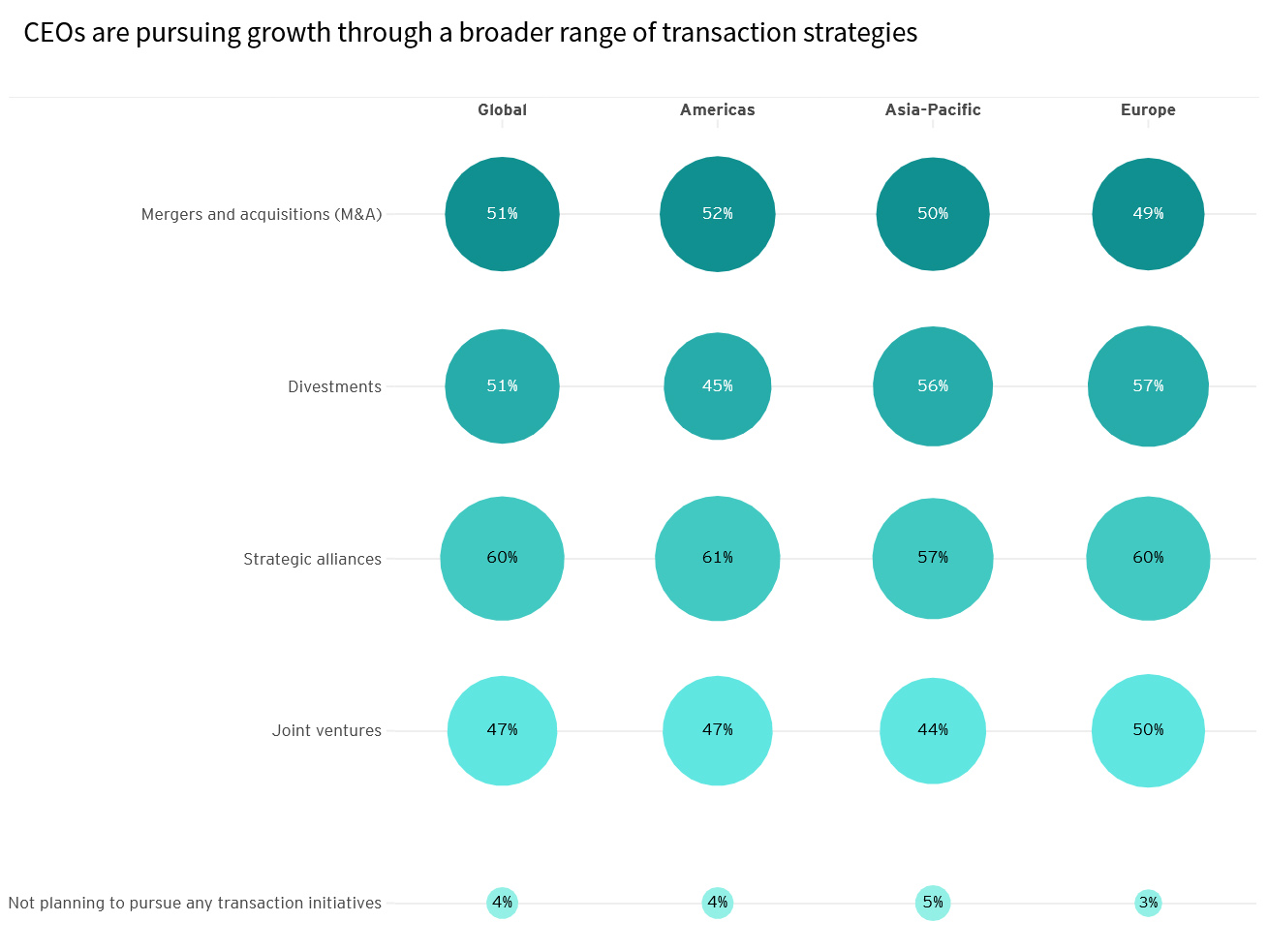
Nearly all CEOs surveyed (96%) plan to pursue some form of transaction in the next 12 months. In addition to acquisitions, 51% of leaders are actively pursuing strategic alliances and joint ventures. Additionally, CEOs are prioritizing divestments, as organizations look to release capital, reduce complexity and sharpen strategic focus with 51% of CEOs planning to pursue a divestment in the next 12 months.