MENA transactions in H1: $96 billion across 865 transactions as capital goes selective

The Middle East and North Africa region recorded $95.6 billion in disclosed transaction value across 865 deals in the first half of 2026. While large M&A transactions and sustained debt issuance supported market activity, fewer deals, subdued IPO activity and greater capital concentration point to an increasingly selective investment environment.
These are among the headline findings of Lincoln International’s latest M&A transactions report, which provides a consolidated overview of regional transaction and private capital activity through June 2026. The report examines developments across mergers and acquisitions, private equity, venture capital, debt financing, IPOs, exits and fundraising, against a backdrop of geopolitical uncertainty and volatility in energy markets.
M&A transactions accounted for approximately 50% of disclosed transaction value, while debt represented another 38%. Venture capital contributed 6% of value, with IPOs, public equity and private equity making up the remainder.
From a sector perspective, technology attracted the largest share of capital, with $33.4 billion in disclosed transactions, followed by financial services at $26.7 billion and energy and utilities at $13.2 billion. Together, these three sectors accounted for more than three-quarters of total disclosed transaction value.
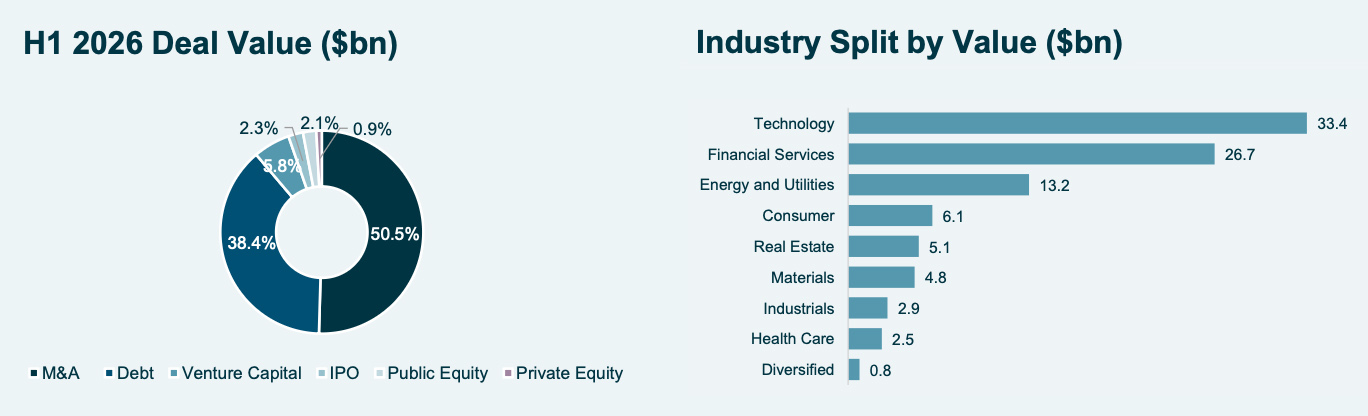
The figures highlight the importance of technology and financial services to the region’s investment landscape, while the substantial contribution from energy and utilities reflects the continued strategic importance of the sector. Consumer businesses, real estate, materials and industrials also attracted investment, although at considerably lower levels.
Geographically, the GCC remains the principal center of regional capital formation, with the UAE and Saudi Arabia continuing to benefit from sovereign-linked investment, established institutional investors and increasingly developed domestic capital markets.
M&A transactions
The mergers & acquisitions (M&A) segment remained the largest component of the MENA transaction market in H1 2026. The segment recorded 302 transactions, approximately 10% fewer than the 335 deals reported in the first half of 2025. Despite the decline in volume, disclosed M&A value increased substantially, reaching $48.2 billion.
The comparison with previous periods illustrates the scale of this increase. M&A transaction value stood at $21.8 billion in H1 2024 and $24.7 billion in H1 2025, meaning 2026’s first half represents almost double the value recorded in the same period a year earlier.
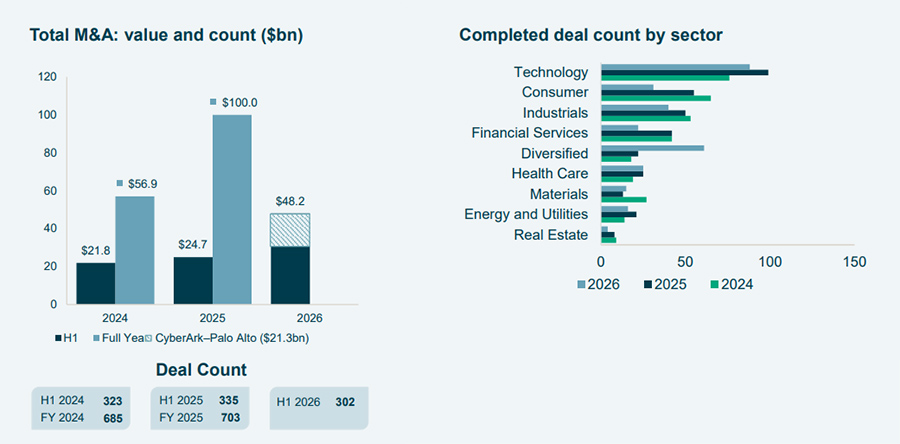
A significant contributor was the announced $21.3 billion acquisition of CyberArk by Palo Alto Networks, one of the largest technology transactions ever in the region’s deal scene.
The distinction between transaction value and deal volume is important. Rather than indicating a broad-based acceleration in M&A activity, the figures suggest that larger strategic transactions are increasingly determining the overall value of the market. Investors remain willing to commit substantial capital, but the number of transactions being completed has moderated.
The sector distribution of completed M&A deals shows that technology’s continued prominence reflects the strategic importance of digital capabilities, software, artificial intelligence and digital infrastructure. These areas are attracting interest from both strategic acquirers and financial investors, supported by long-term demand for digital transformation and the potential to build scalable business models.
Industrials remained relatively active compared with previous periods, while consumer and financial services transactions showed greater sensitivity to approvals and deal discipline. Healthcare, materials, energy and utilities, and real estate also contributed to the transaction landscape.
The Gulf continues to serve as the foundation for regional M&A dealmaking. The UAE and Saudi Arabia benefit from significant sovereign and state-backed investment capacity, increasingly sophisticated domestic investors and economic diversification programs that generate opportunities across multiple industries.
At the same time, transactions outside the GCC contributed to the resilience seen in the first half of 2026.
According to Lincoln International, the changing composition of M&A activity points to a more demanding environment. Business quality, earnings visibility, valuation discipline and the ability to execute transactions in uncertain conditions are becoming increasingly important considerations.
Private capital
Although transaction volumes in private equity and venture capital have moderated, capital continues to flow into businesses and sectors with strong growth prospects, particularly technology, software, artificial intelligence and digital infrastructure.
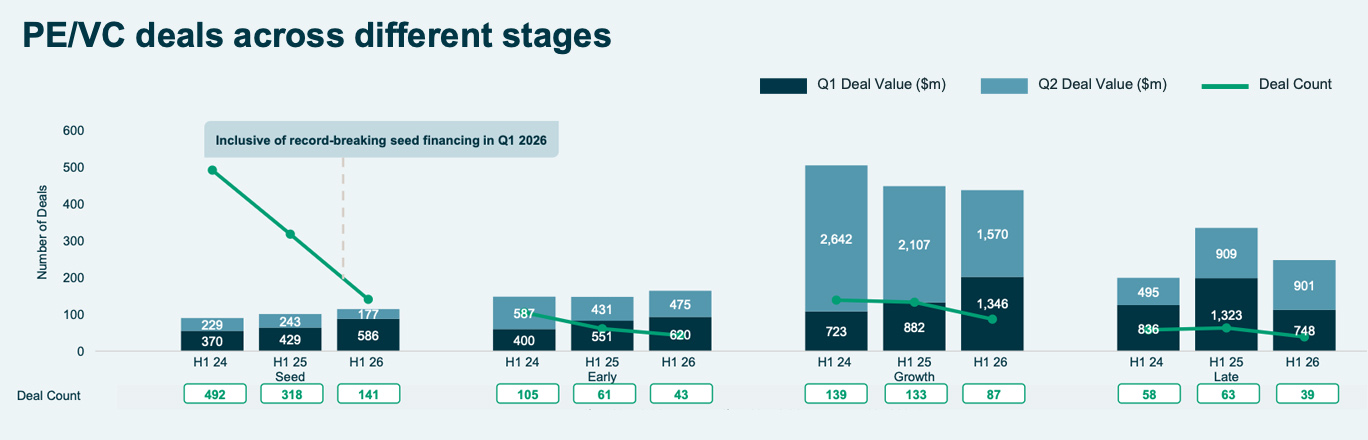
One of the most notable developments is the increasing concentration of investment. The 15 largest transactions accounted for 51% of all private capital deployed, representing a 12-percentage-point increase year over year. This indicates that a growing proportion of available capital is being allocated to a relatively small number of larger opportunities.
Technology remains the dominant investment theme, accounting for 69% of private equity and venture capital transaction value. Israel continued to serve as a major value engine for the broader MENA technology investment landscape, while the UAE and Saudi Arabia remained important centers of deal activity within the GCC.
The investment-stage breakdown from the author’s reveals different dynamics across the private capital ecosystem.
Seed-stage deal volume declined considerably, falling from 318 transactions in H1 2025 to 141 in H1 2026. Early-stage activity also fell, however, disclosed investment value increased from approximately $882 million to $1.1 billion. Growth-stage investment remained substantial with disclosed investment at $2.9 billion, compared with around $3 billion in H1 2025, despite a decline in the number of transactions declined from 133 to 87.
The data suggests that investors are committing more capital to a smaller number of businesses that have progressed beyond the earliest stages of development. “Larger financing rounds are increasingly concentrated in businesses with stronger commercial prospects, more established operating models or a clear path to scale,” said the authors.
3) Debt transactions
Debt financing continued to play a central role in the region’s capital markets. H1 2026 saw sustained credit issuance across a broad range of borrowers, with banks and sovereign entities among the leading issuers.
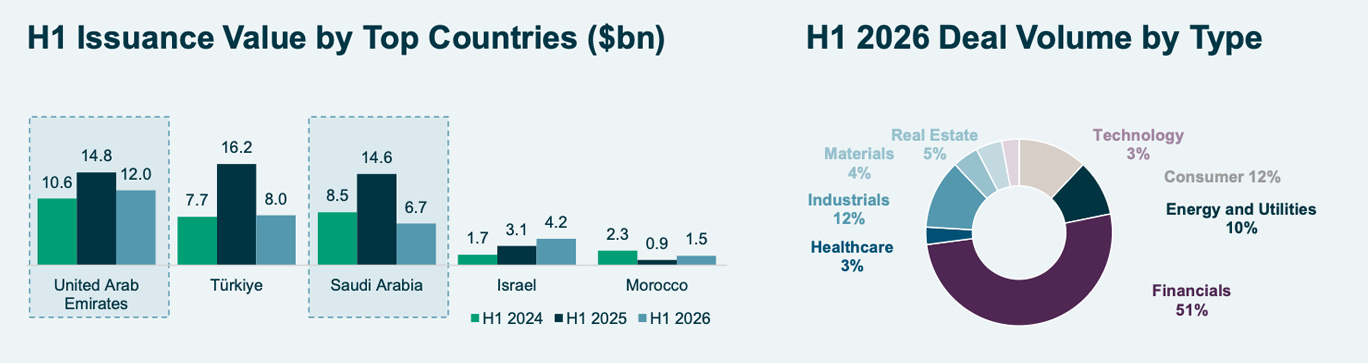
GCC debt issuance reached approximately $1.2 trillion during the first half of the year, according to the report’s figures. Sukuk accounted for around 40% of issuance, while more than 60% was denominated in US dollars, underlining the continued importance of international capital markets and Islamic financing structures to the region.
The country-level issuance figures show the UAE, Türkiye and Saudi Arabia among the largest markets. The UAE recorded approximately $12 billion in H1 2026 issuance, followed by Türkiye at $8 billion and Saudi Arabia at $6.7 billion. Morocco’s market recorded $1.5 billion.
Financial services accounted for approximately 51% of debt transaction volume, making it by far the largest borrower sector. Consumer businesses and industrials each represented around 12%. The energy & utilities, real estate, materials, technology and healthcare sectors made up smaller portions of the market.
Lincoln International said that private credit is emerging as an increasingly important source of capital. Beyond the established role of banks and public debt markets in the regional financing ecosystem, private credit assets under management reached approximately $5 billion in 2025 and are projected to grow by around 15% annually over the following three years.
This expansion reflects demand for more flexible financing structures, particularly among companies seeking capital solutions that can’t access traditional lending structures or seeking more tailored solutions.
IPO activity
The region’s IPO market experienced a challenging first half of 2026. The number of initial public offerings (IPO) fell sharply, with the number of listings declining from 27 in H1 2025 to just 7 in H1 2026.
The decline was accompanied by lower proceeds. IPO proceeds in the GCC fell from $4.1 billion in H1 2025 to approximately $1.2 billion in H1 2026. Non-GCC markets generated around $1.1 billion, compared with $1.8 billion a year earlier.
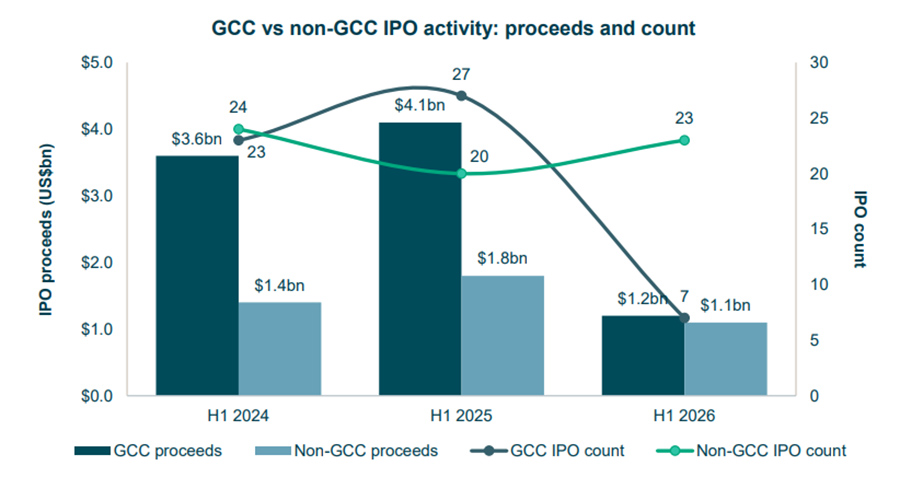
Several factors contributed to the slowdown in the GCC. Geopolitical tensions increased market volatility, prompting some issuers to delay or reassess their listing plans. Investor selectivity also intensified following weaker aftermarket performance from several recent regional IPOs, with some newly listed companies trading below their offering prices.
In addition, the slowdown reflects a degree of normalization following the exceptionally active 2021–2024 period, when privatizations and large-scale IPOs helped drive regional listing activity to record heights.
The contrast between the GCC and non-GCC markets is particularly notable when looking at the number of listings. While GCC IPO count dropped to seven, non-GCC activity increased from 20 to 23 listings. This suggests that, although public market issuance slowed significantly in the Gulf, other MENA markets continued to provide opportunities for companies seeking access to public equity.
Looking ahead, the researchers said that underlying IPO pipeline remains meaningful, although all eyes will go to the conversion of prospective listings into completed transactions. “H1 2026 appears to be a timing-driven dislocation rather than a structural reversal. H2 activity could shift back toward the GCC as the pipeline converts, while non-GCC markets may continue to provide greater breadth amid selective issuance windows.”
Valuation expectations, investor demand, earnings visibility and the prospect of stable aftermarket performance are all expected to play a greater role in determining whether companies proceed with their listings.
Exit activity
The exit market reflects many of the same dynamics evident in M&A and IPO activity. While disclosed exit value strengthened in H1 2026, the overall number of exits remained subdued, indicating that liquidity opportunities are increasingly concentrated in a smaller number of larger transactions.
The region recorded 239 exits, approximately 23% fewer than in H1 2024. The decline follows from more selective buyer underwriting and a more challenging environment for investors seeking to realize returns from their portfolio companies.
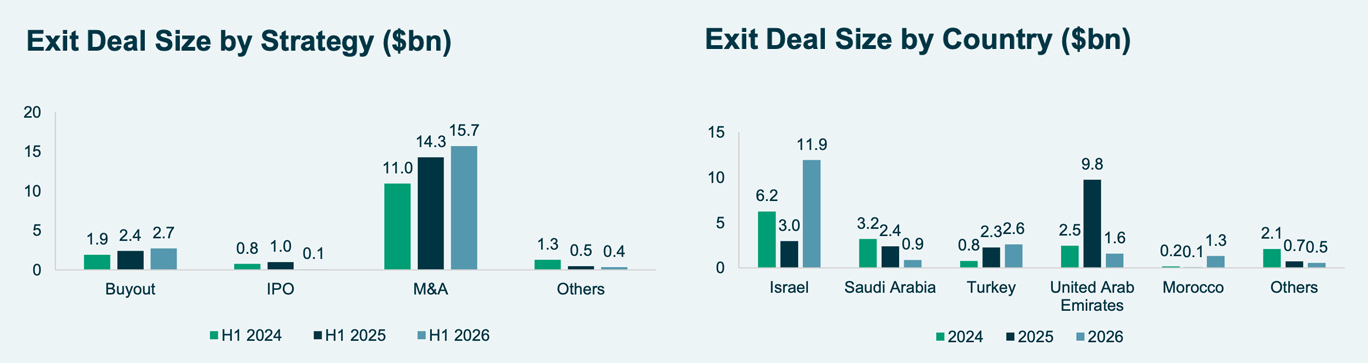
Strategic M&A remained the dominant exit route, generating approximately $15.7 billion in disclosed value, compared with $14.3 billion in H1 2025 and $11 billion in H1 2024. Buyout-related exits also increased, reaching $2.7 billion, while IPO exits contributed just $100 million.
The figures demonstrate the continued importance of strategic buyers in providing liquidity to private equity investors and business owners.
The country breakdown highlights some significant shifts in exit activity, with the UAE’s figure illustrating how country-level exit values can fluctuate significantly depending on the timing of a small number of large transactions.
The authors noted that for private equity investors, the exit environment remains an important consideration when assessing new investments as the ability to generate returns not only depends on the quality of an asset and its growth prospects, but also on the availability of viable exit routes.
Fundraising activity
Despite the more selective investment environment, private capital fundraising continued to develop. Publicly announced private capital fundraising targets reached approximately $2.3 billion across 63 funds in H1 2026, compared with $1.88 billion across 46 funds in H1 2025.
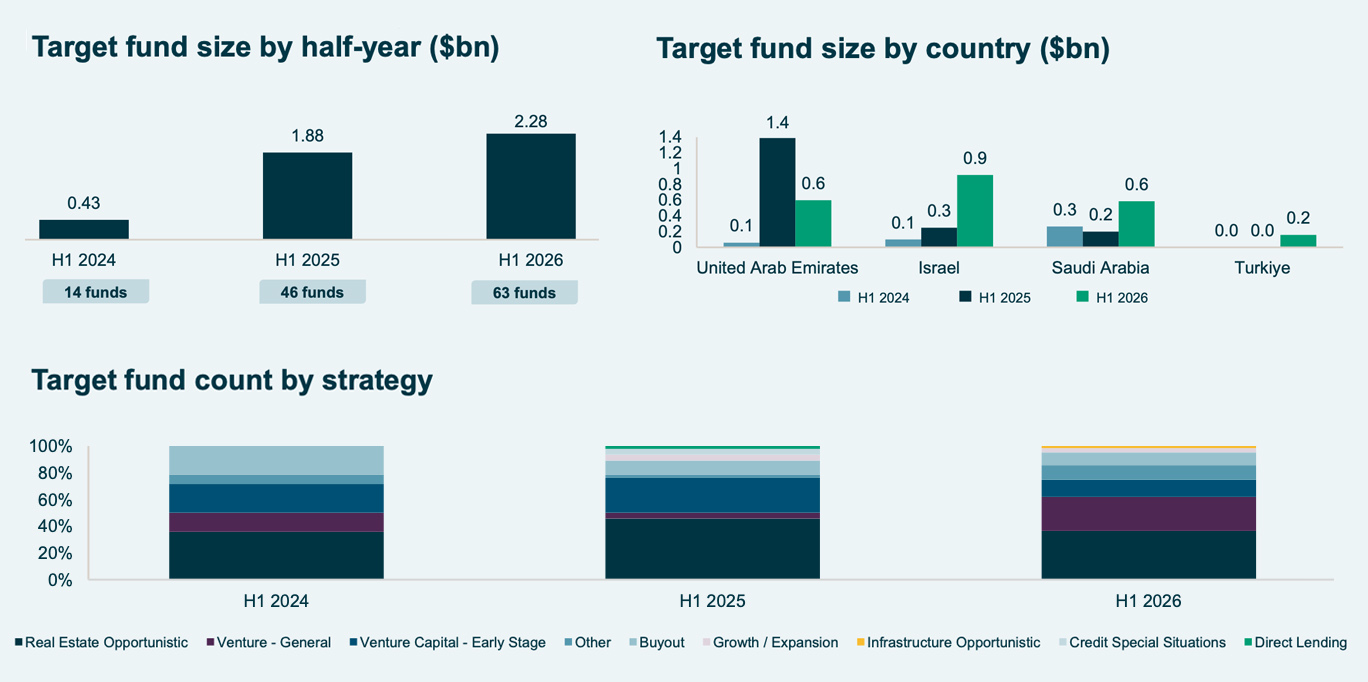
The increase in both fundraising targets and the number of funds represents continued expansion of the regional investment ecosystem. For comparison, H1 2024 recorded approximately $430 million in target fundraising across 14 funds.
The UAE accounted for approximately $600 million in fundraising targets, while Saudi Arabia recorded around $600 million. Türkiye contributed approximately $200 million.
The upwards trajectory shows that the regional fund formation pipeline is becoming broader, even as investment deployment is increasingly concentrated. More funds are being established to address opportunities across different strategies, geographies and stages of company development.
The range of fund strategies also points to a diversifying ecosystem. Venture capital, early-stage investing, buyouts, real estate and growth-oriented strategies all contribute to the fundraising landscape, alongside more specialized investment approaches.
Building on resilience
Taken together, Lincoln International’s findings point to a MENA transaction market that remains active and well positioned for continued development, although activity and investment dynamics vary across individual markets and sectors.
“The Middle East continues to distinguish itself as an increasingly important global capital market. H1 2026 demonstrated continued transaction resilience. However, the nature of deployment has evolved, with greater emphasis on execution certainty, strategic relevance, earnings visibility and resilient cash flows,” the researchers noted.
Looking ahead to the remainder of 2026, the selective investment environment is expected to persist. The key challenge is not a shortage of available capital, but rather the ability of businesses and investors to identify, execute and realize value from high-quality opportunities.
The region’s transaction outlook will ultimately depend on the interplay between geopolitical developments, energy market conditions, investor confidence and companies’ ability to meet increasingly demanding investment criteria.