Global satellite race accelerates amid connectivity boom and sovereignty concerns

The number of satellites orbiting Earth could increase more than eightfold in the coming years as major technology and space companies, alongside governments, accelerate plans to build large-scale satellite constellations. The expansion is set to reshape the global connectivity market, intensify competition for spectrum and raise important questions around national sovereignty.
That are the central messages in a new whitepaper from Detecon, a leading consultancy in the ICT and telecoms market. The report examines the emerging competitive landscape and the regulatory challenges facing governments as satellite technology becomes an increasingly important part of digital infrastructure.
The scale of the anticipated expansion is big. According to Detecon’s analysis, more than 11,907 satellites have already been launched for low Earth orbit (LEO) and medium Earth orbit (MEO) internet, Direct-to-Device (D2D) and Internet of Things services.
If all planned satellites were deployed, this number would rise to more than 97,000.
The competitive landscape remains heavily concentrated. Starlink, operated by Elon Musk’s SpaceX, has approximately 10,000 satellites in orbit and accounts for 84% of all launched LEO and MEO satellites.
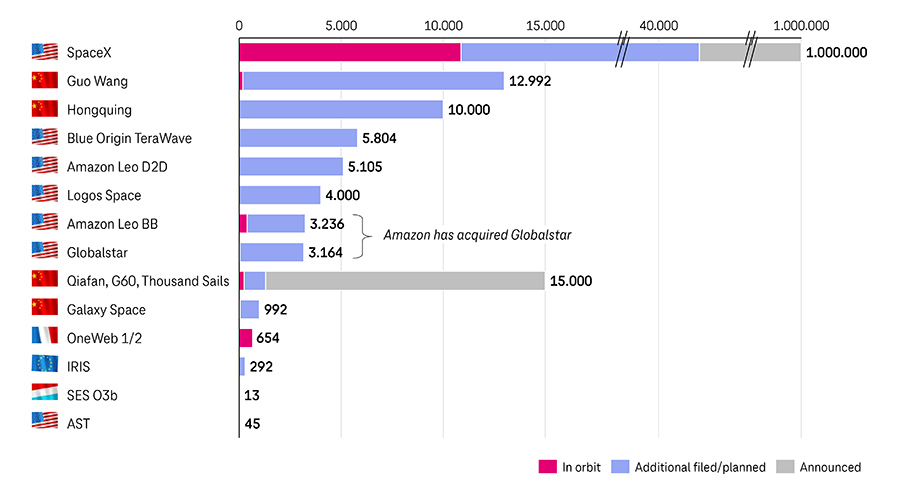
However, a growing group of competitors is preparing to challenge its position. Amazon Leo has plans for 3,236 broadband satellites and 5,105 D2D satellites, while Blue Origin’s recently announced TeraWave constellation comprises 5,804 planned satellites.
China is also positioning itself as a major competitor. Its planned programmes include Qianfan (Thousand Sails), with 15,000 announced satellites, Guowang with 12,992 planned, and Honghu-3 with 10,000. Other initiatives include Logos Space in the US and the European Union’s IRIS programme.
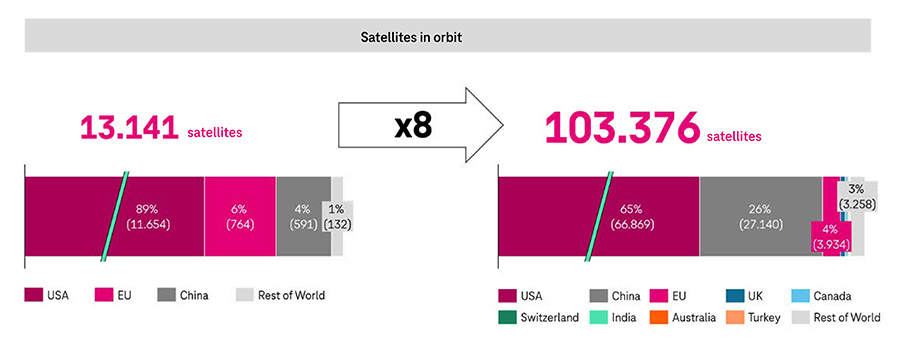
The geographical distribution of this expansion is particularly revealing. Detecon’s projection estimates that the satellite population could grow from 13,141 to over 103,000 in a few years, an eightfold increase.
While the US currently accounts for 89% of the satellites in the analysis, its projected share will fall to 65%, or close to 67,000 satellites. China’s share is expected to rise from 4% today to 26%, positioning it as a significant challenger to US dominance. The EU’s projected share is anticipated to drop slightly.
Sovereignty becomes a strategic consideration
Beyond commercial competition, the expansion raises questions about who ultimately controls critical communications infrastructure in space. Detecon’s authors argue that satellite sovereignty has no universally accepted definition and should be assessed across three dimensions: military use, government funding and secure government communications, and potential deployment in military conflict zones.
The EU’s IRIS programme illustrates the strategic importance of sovereign infrastructure. Designed for civilian, government and potential military applications, the planned constellation will comprise 18 MEO, 264 LEO and 10 Very-LEO satellites.
Yet building independent infrastructure is financially and technically challenging. Many countries cannot afford their own constellations and will need to rely on foreign providers. This creates a delicate balance between expanding connectivity and maintaining control over critical national infrastructure.
Market access and regulation will shape the next phase
Detecon expects the competitive landscape to increasingly reflect geopolitical divisions. Western markets may favour providers from allied countries, partly due to national security and privacy concerns, while China is likely to serve its domestic market and support Chinese commercial interests abroad.
Other countries will largely determine access through their national regulatory frameworks, with established Western operators likely to gain an early advantage in shaping market conditions.
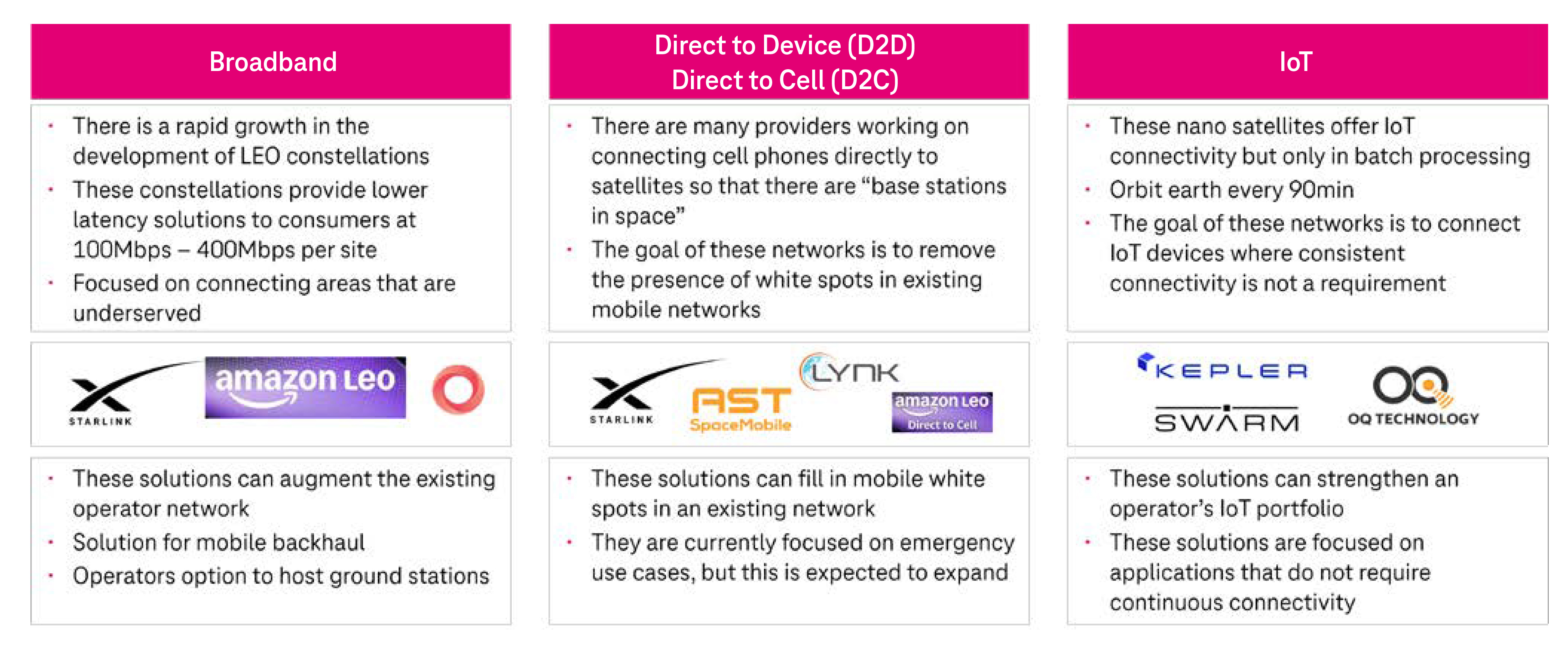
For regulators, the challenge is to ensure that foreign satellite providers compete on fair terms with domestic telecommunications operators. This includes reconsidering licensing requirements, spectrum allocation, interference management and spectrum fees. Satellite operators should not gain an unfair advantage by avoiding obligations imposed on terrestrial mobile providers.
The report identifies four areas requiring regulatory attention over the next 12–24 months: satellite spectrum access, proportionate spectrum fees, domestic market access and licensing frameworks. It also highlights the importance of developing clear rules for D2D services, which could either complement existing mobile networks or become direct competitors.
Key takeaways
Ultimately, the next phase of the satellite race will be determined not only by technological innovation and the number of satellites launched, but also by the regulatory and geopolitical conditions governing their use. Governments that establish clear, investment-friendly frameworks while protecting national interests will be better positioned to benefit from the expanding space-based connectivity market.