Roshn Saudi League raises on-pitch quality as football league enters next phase

Bain & Company and Twenty First Group have once again teamed up to analyze the performance of the Roshn Saudi League, finding that the competition is becoming increasingly compelling on the pitch, while identifying priorities for turning momentum into more on-pitch competition and off-pitch league value.
The latest season of the Roshn Saudi League delivered one of the league’s tightest title races, with Al-Nassr ultimately claiming the title with just two points more than Al-Hilal. Reflecting the intensity at the top of the table, the gap between the first- and fourth-placed teams was just nine points. By comparison, Europe’s top leagues had an average gap of 21 points between the league winner and the team finishing fourth.
According to Bain & Company and Twenty First Group, this increased competition is positive for the league because competitive balance is central to the appeal of any sports competition.
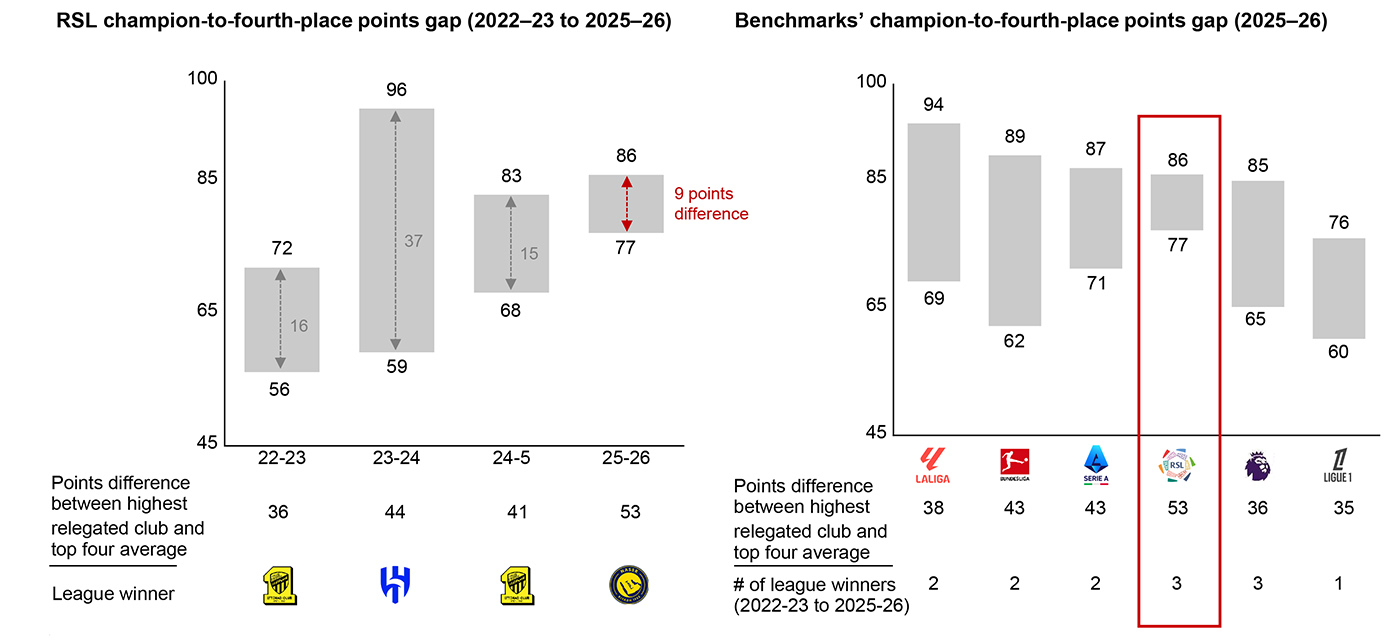
A tighter race for the title and European qualification can increase fan excitement, sustain interest deeper into the season, and encourage greater engagement both in stadiums and across digital channels. It can also help make individual matches more meaningful, as more teams remain in contention for higher positions for longer.
This has long been an achilles heel of many European competitions, where title winners and contenders for European qualification have tended to be concentrated among a relatively small group of clubs. Greater competitive balance can therefore be an important factor in building a league that is attractive not only because of its star players, but also because of the uncertainty and quality of the competition itself.
Overall, the authors found that the Roshn Saudi League has continued to improve its on-pitch quality, notably through the arrival of high-profile signings and a broader pool of quality players. The competition’s average team quality increased marginally from 41.6 to 42.1. This places the Roshn Saudi League among Asia’s leading competitions, behind only the J1 League, although a significant gap with the world’s top leagues remains.
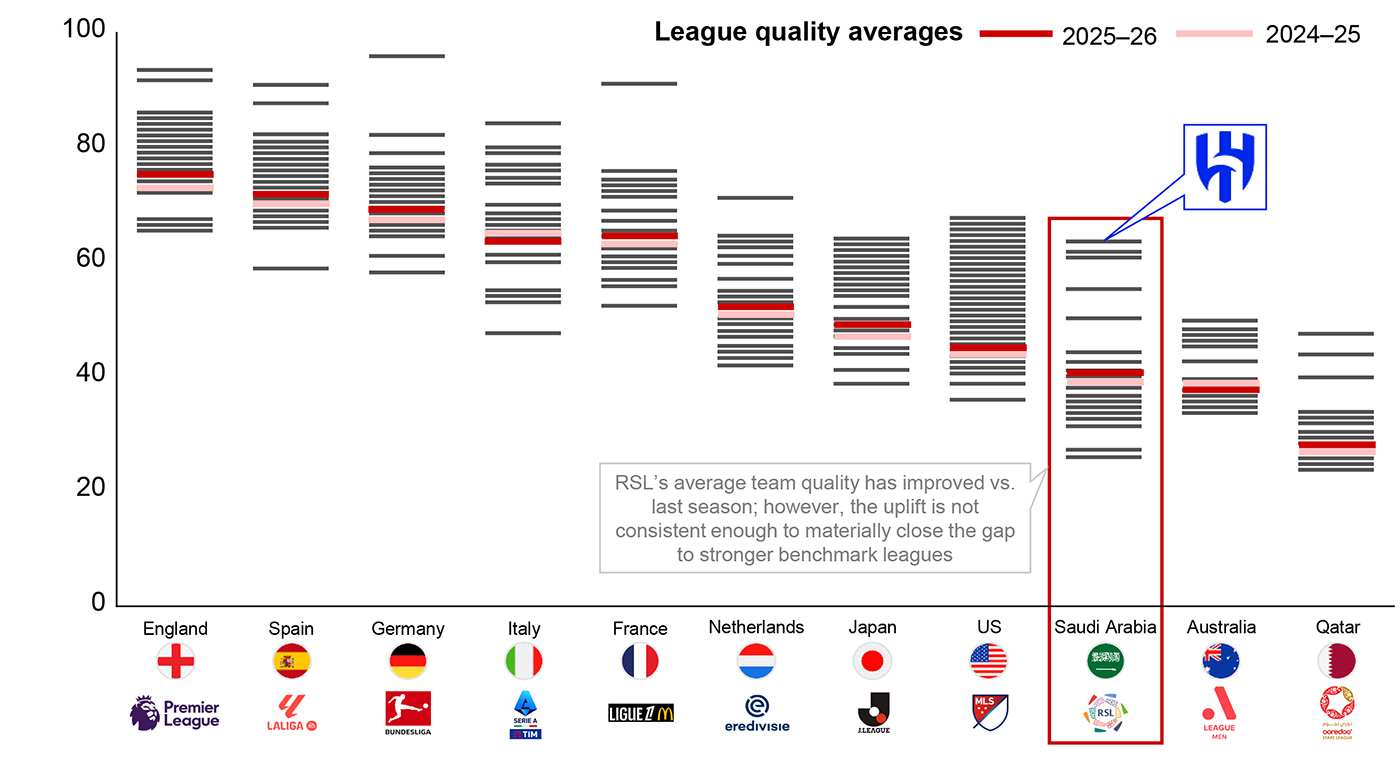
Player values continued to rise, with average player value increasing from $1.05 million in 2024/25 to $1.13 million in 2025/26. However, quality and value remain concentrated at the top, with the top five finishers now accounting for 76% of the league’s total squad value.
“Competition at the top is getting tighter, and the quality of the leading clubs continues to rise,” said Jürg Kronenberg, Partner and Head of the EMEA Sports practice at Bain & Company.
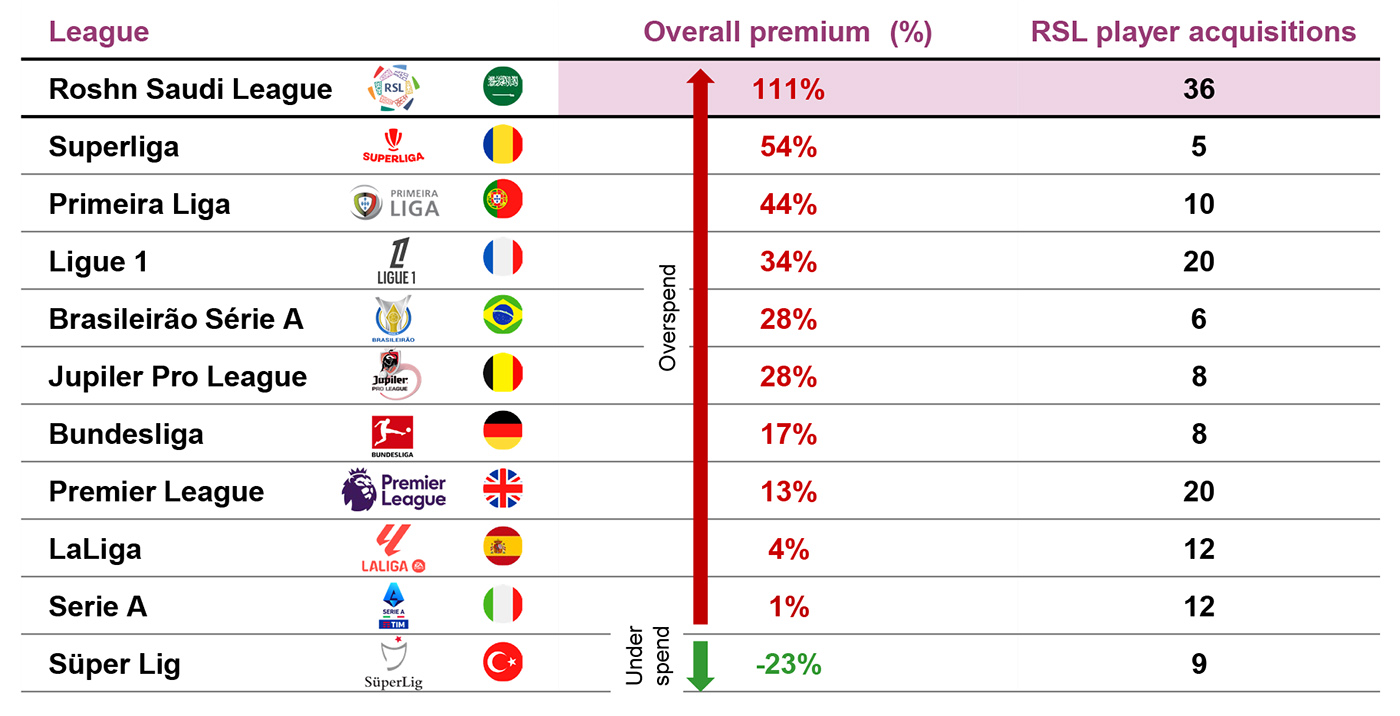
That growth, however, remains what the authors describe as “heavily acquisition-led.” Around 89% of squad value growth came from player acquisitions rather than organic development, while Roshn Saudi League clubs shifted from underspending by 6% in 2024/25 to paying a 35% premium to estimated transfer value in 2025/26.
Some of the biggest arrivals in the Roshn Saudi League over the past year have included Tijjani Reijnders, who joined Al-Qadsiah from Manchester City for around €61 million; Mateo Retegui, who moved from Atalanta to Al-Qadsiah for a reported €62 million; Darwin Núñez, who joined Al-Hilal from Liverpool for around €70 million; Crysencio Summerville, who moved from West Ham United to Al-Hilal for around $73.5 million; and Ollie Watkins, who joined Al-Hilal from Aston Villa for around $66.6 million. Reijnders’ €61 million transfer was confirmed in August 2026, while the other figures are based on reported transfer fees.
The report found that most recent transfer activity into the league has come from the Premier League and Ligue 1. Across the board, Saudi clubs are also having to pay significant premiums to attract players, highlighting the importance of improving transfer-market efficiency as the league enters its next phase of development.
Club versus club metrics
The authors also highlight interesting differences in club performance across a range of metrics. Al-Hilal led the Roshn Saudi League in starting squad quality and depth, while Al-Hazem was the league’s clearest overachiever, converting the lowest-rated starting squad into a mid-table finish.
Al-Qadsiah recorded the strongest growth in average player value, more than doubling it year over year, while Al-Hazem was the only club to generate positive organic squad value growth, at 108%.
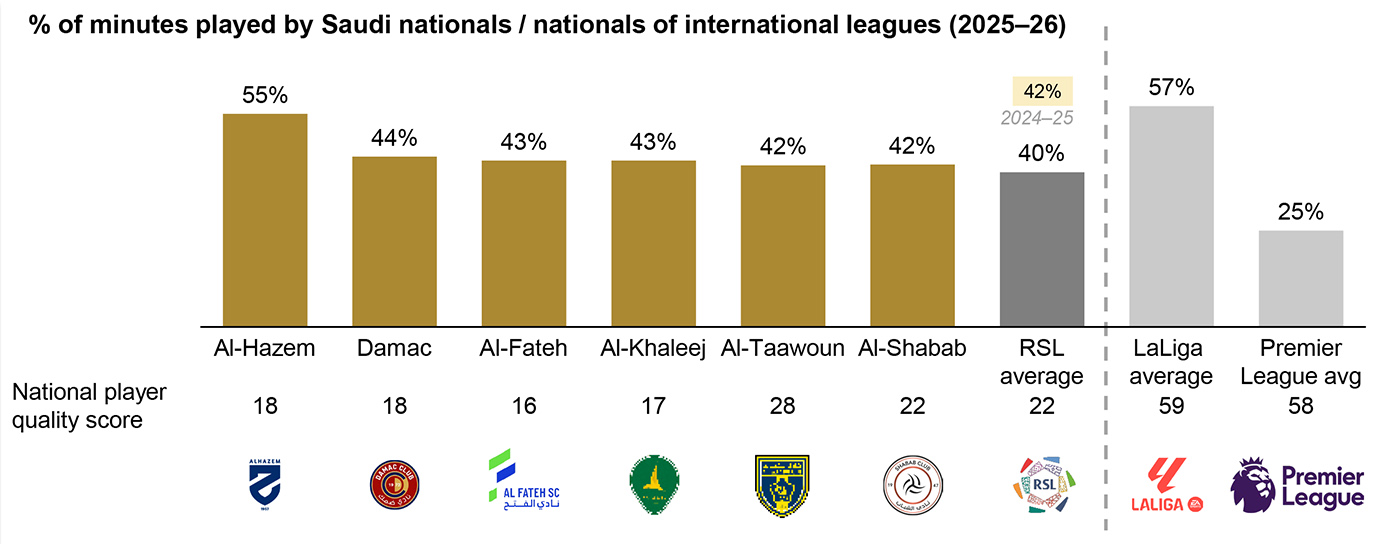
NEOM S.C. led the league in U23 playing time at 36%, while Al-Hazem recorded the highest share of minutes played by Saudi nationals, at 55%. In terms of fan engagement, Al-Nassr led with around 57 million social media followers and 83% stadium utilization, while Al-Ahli recorded the league’s highest average attendance, at roughly 23,400 spectators per match.
Youth development
In terms of youth development, the authors found that playing time for younger players rose marginally across the league, but overall local youth exposure in the Roshn Saudi League declined from 9% to 7%. The trend in homegrown talent is also a concern for the future development of the Saudi national team, with Saudi nationals’ share of playing time falling from 42% to 40%, while Saudi U23 playing time declined from 9% to 7%.
NEOM S.C. led the league in U23 playing time, well above the 15% league average, while Al-Qadsiah ranked second. The figures point to a growing need for clubs to create stronger pathways from youth academies into first-team football if the league is to convert its investment in infrastructure and talent into a deeper pool of locally developed players.
Next phase
Reflecting on the report, Kronenberg said that as the Roshn Saudi League continues to mature and grow, the next challenge is to turn that momentum into sustainable progress across the league. This will require clubs to spend more efficiently, develop more talent through their academies, and build stronger fan experiences.
Another key objective should be to narrow the gap between the top clubs and the rest of the league, helping to sustain the competitive balance that has emerged as one of the competition’s strengths.
The analysis identifies five priorities for the next phase of growth: further professionalize smaller clubs; improve transfer and wage-spend efficiency; reduce reliance on acquisitions through stronger organic player development; build clearer academy-to-first-team pathways for Saudi talent; and strengthen the matchday and digital fan experience.