3x3 sports: The cheapest Olympic medal and the most tokenizable sports asset

Four players, one half-court and ten minutes of play make 3x3 the most capital-efficient route to an Olympic podium – and the most franchise-able product in sport. Paul Lalovich and Vladan Dragosavac of Agile Dynamics explore the sport’s commercial potential and explain how its format creates opportunities for scalable, commercially viable sports franchises.
The economics of 3x3
The most expensive mistake a federation can make with 3x3 basketball is a linguistic one. Call it a “format” and it lands inside the five-a-side department, receives a modest event budget, borrows players when they are free, and is judged on tournament results. That framing misses almost everything that matters. 3x3 has its own game economics, athlete economics, venue economics, media economics and qualification economics. It is not smaller basketball. It is a different asset.
The rules compress the product radically. One basket, one half-court, three players plus a substitute, a 12-second shot clock, and a game that ends at ten minutes or when a team reaches 21. A single court can process dozens of games a day. A four-person roster is an entire national team. Dead time is minimal, highlights are constant, and the score is legible to a casual viewer in seconds. Elite events are routinely staged on temporary courts in city centres; grassroots play runs on upgraded outdoor facilities that already exist.
Economically, then, 3x3 sits somewhere between an Olympic discipline, an urban festival, a short-form media property, a travelling team circuit, a city-marketing platform and a youth participation product. That matters because programmes and assets are financed differently. A programme consumes an annual budget. An asset is expected to build capability, audience, intellectual property and recurring cash flow.
The investment case begins the moment 3x3 moves from the first category to the second.
LA28 changed the arithmetic
Los Angeles 2028 expands the Olympic 3x3 tournaments from eight to twelve teams per gender. With the United States qualified as host, eleven places per gender are open. Five will be allocated through the FIBA 3x3 Federation Ranking as it stands on 1 December 2027 – one each for Africa, the Americas and Europe, and two for Asia-Pacific, at least one of them reserved for an Asian nation. The other six per gender will be decided through four qualifying tournaments between March and June 2028, including a Universality event restricted to nations that did not play Olympic basketball at Tokyo or Paris.
This is strategically significant because Olympic access is not concentrated in one narrow funnel. A well-run federation can pursue several routes simultaneously, and the IOC’s urban Olympic Qualifier Series turns part of the qualification process into a media property in its own right. The objective, therefore, is not to “put a team together for a qualifier.” It is to build a two-year ranking machine that manufactures more than one path to Los Angeles.
The cheapest medal, properly defined
“Cheapest medal” is shorthand, and it should be used precisely. We do not claim an audited league table proves 3x3 is the lowest-cost discipline on the Olympic programme; national programme budgets are rarely published. The claim is structural: 3x3 offers unusually high medal probability per marginal dollar of high-performance investment. The right metric for an Olympic committee is probability-adjusted medal value divided by incremental programme cost.
Both halves of that ratio favour 3x3. The numerator includes more than the medal: national visibility, government incentives, sponsorship, youth engagement, tourism exposure and the commercial ecosystem the programme leaves behind. The denominator is genuinely incremental. A nation that already has courts, coaches, strength staff, federation administration and event capability can reuse most of that installed base. It does not need to build a professional league before fielding a competitive unit. It needs to find a small number of the right athletes and expose them relentlessly to the specific physical, tactical and decision-making demands of the game. The word is not cheap. It is capital-efficient.

The competitive evidence supports the thesis. Nations without dominant five-a-side leagues have reached the top of the discipline: FIBA’s own federation rankings have featured Mongolia among the world’s leading countries, and Serbia has built one of the deepest professional 3x3 ecosystems anywhere. Success is not easy. But the competitive production function is unusually accessible to a mid-tier nation that decides to take it seriously.
Ranking is capital, and it compounds
For the LA28 cycle, federation ranking counts results over a 24-month window that began on 1 December 2025. Decisions taken in 2026 therefore carry 2028 consequences. A federation that starts seriously in January 2027 is not competing with its rivals’ January 2027 programmes; it is competing with everything they banked during 2026.
Ranking compounds participation, participation builds experience, experience lifts performance, performance unlocks better events, and better events produce ranking points, visibility and sponsorship – which fund more participation.
As of September 2026, more than nine months of that window have gone. The commonly cited 18-month standing-start window is directionally right but generous: for the ranking route specifically, the effective deadline is sooner. Competitors keep accumulating points, specialist players keep gaining experience, stable teams keep deepening their chemistry, and the best coaching and event partners get harder to secure. The programme needs to be operational now.
A product built for the smartphone
Many sports have had to adapt to social media. 3x3 looks as if it was designed for it. A ten-minute game is a complete narrative arc. The shot clock drives event frequency; the one-and two-point scoring creates sudden swings; six players on a compact court are easy to frame; fans sit close to the action; music and brands coexist naturally with competition. Every game throws off moments that make sense out of context.
The numbers confirm it. FIBA reports that its 3x3 ecosystem generated 1.5 billion impressions, 1.1 billion video views and 118 million engagements in 2025, with social followers passing 10 million and roughly 70% of the audience aged 13–34. It estimates the sport delivered $220 – $290 million in media value for sponsors that year, and World Tour coverage reached more than 200 territories. That is not the footprint of a niche derivative. It is an emerging media category.
The league premium
Sophisticated capital keeps returning to sports franchises for a reason. Indexed to 2004, the average NBA team is now worth roughly twenty times its starting value, and MLS clubs have compounded by a similar multiple since Forbes first valued them in 2008. NHL and NFL franchises are up about thirteen-fold and MLB roughly ten-fold, against a six-fold price gain for the S&P 500.
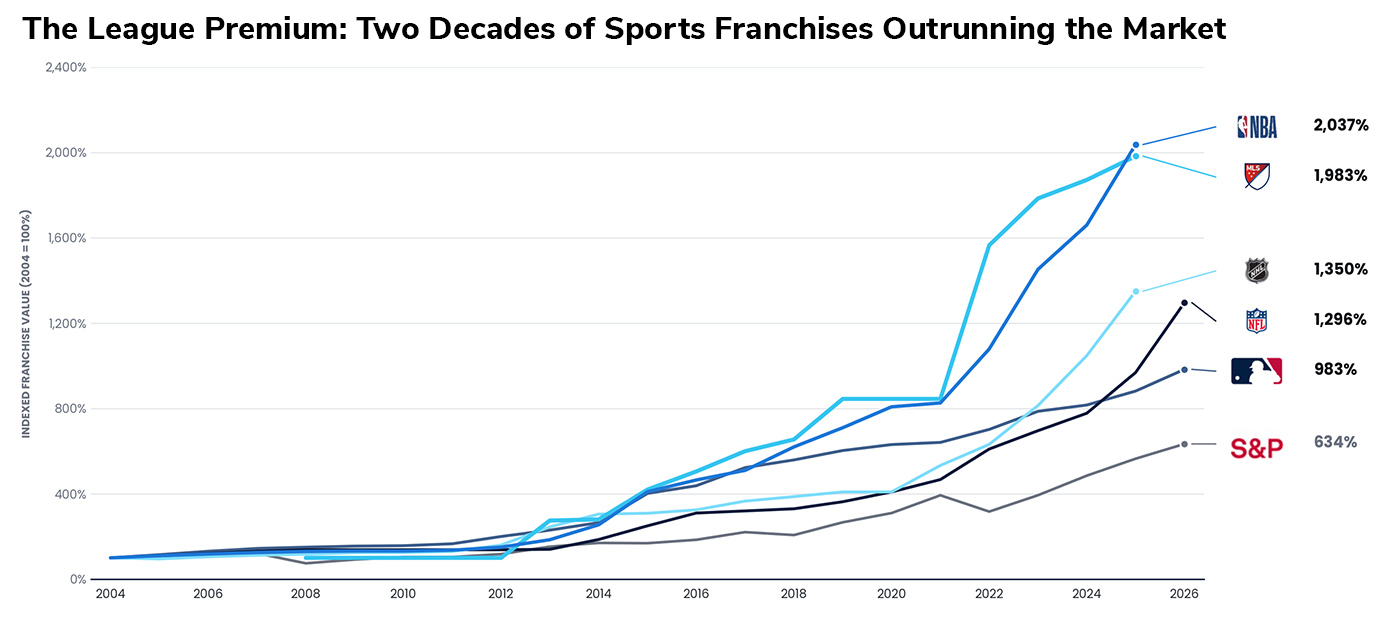
The League Premium is an architecture premium, not a reward for athletic excellence. It is produced by design: a fixed number of licences, collectively sold media rights, cost controls that protect margins, and a widening pool of institutional buyers. Forbes attributes much of the NFL’s latest jump – the average team up 34% in a year, to US$9.5 billion – to scarcity itself.
The problem for a new investor is the entry ticket. The premium is already in the price: every NFL franchise is now valued above $8 billion, and an MLS expansion slot costs around $500 million. The returns accrued to those who built the leagues or bought in while they were small. The premium belongs to the architects, not the late buyers.
That is the central lesson for 3x3. The sport already holds the raw materials: scarce sanctioned places on a global circuit, an Olympic pathway that confers scarcity no commercial league can manufacture, short-form media built for young audiences, and franchise units small enough to license city by city. What it lacks is the architecture – licensed franchises, pooled media and data rights, and governance that protects integrity. Value will accrue to whoever builds it first.
This is not a forecast that 3x3 will follow the NBA’s curve; most new leagues fail. The point is narrower: the drivers of the League Premium can be designed into an Olympic sport at micro-franchise cost.
High rights density, low physical complexity
A traditional basketball franchise is a heavy asset: arena relationships, large rosters, long home schedules, significant fixed cost. A 3x3 franchise is a micro-franchise. Its roster is four players, its identity travels, its home venue can be a waterfront or a mall concourse, and its season can blend domestic appearances with the international circuit. It looks less like a basketball club and more like a compact sports-IP company.
That is why 3x3 is unusually tokenisable. The product disaggregates cleanly along an asset graph – player, team, city, event, season, federation, Olympic pathway – and every node generates identifiable rights. Players produce identity and content; teams produce franchise IP; city events produce ticketing, hospitality and sponsorship inventory; federations produce sanctioned competition and participation credentials; the Olympic pathway supplies scarcity and global attention. Small, repeatable units are far easier to model digitally than the sprawling economics of most traditional sports.
Tokenise rights, not enthusiasm
Precision matters here. Tokenisation should never mean bolting a speculative coin onto a basketball tournament. The opportunity is to represent real commercial, access and participation rights digitally, with programmable transfer rules and transparent settlement. Our experience building real-world-asset tokenisation models across industries – including structuring token products from a football league’s media rights, IP, sponsorship and performance data – points to three tiers.
The first two tiers are loyalty and identity infrastructure: portable sporting records and programmable fan relationships. The third is different in kind. Once a token carries an expectation of profit from the efforts of others, securities, collective-investment and financial-promotion rules apply, jurisdiction by jurisdiction. Tokenisation does not remove securities law; it makes rights infrastructure programmable.
The discipline is always the same: identify the real-world right, establish the legal issuer, determine the regulatory category, encode the permitted lifecycle, and connect the digital record to actual fulfilment. The first generation of sports tokens tokenised enthusiasm. The next generation should tokenise rights – and Tier 3 offers regulated access to the League Premium where it is created, not after it is priced in.
Why the GCC and Asia fit
The Gulf combines dense urban centres, destination-event strategies, young digitally active populations, premium sponsors and a clear policy appetite for globally visible events – and Manama already sits on the World Tour calendar. A Gulf 3x3 strategy needs no stadium. Courts can be placed against financial districts, waterfronts, heritage sites and retail destinations, bringing the sport into existing consumer traffic. Every clip becomes destination marketing: the city stops being the venue and becomes part of the content. Host-city economics are therefore materially better than gate receipts suggest.
Asia may be the larger opportunity. Major events already run across China, Japan, Mongolia and Hong Kong, and the region holds two guaranteed ranking-route places per gender. The prize is not a single national team but a network of city franchises and events linking the Gulf, South and Southeast Asia, and North-East Asia, inserted into the dense urban environments where consumers actually live.
One operating model, six layers
A serious national programme connects six layers vertically: mass participation; 3x3-specific talent identification; a domestic elite circuit of city or corporate teams; repeated professional international exposure; an Olympic programme that emerges from the professional ecosystem rather than being assembled every few months; and a commercial platform that monetises the whole system through sponsorship, media, events, franchising, academies, data and digital membership.
The crucial reframe is that participation is not CSR; it is customer acquisition. A fifteen-year-old entering a city tournament can become a registered player, a member, a fan, a content viewer, a ticket and merchandise buyer, an academy athlete and, occasionally, an Olympian. The funnel is commercially valuable even though almost no one reaches the podium.
The cleanest structure separates a federation – holding sanctioning, selection, integrity and Olympic representation – from a commercial operating company that runs teams, events, media and consumer products under a long-term agreement with reserved matters agreed before capital is deployed. That separation also gives capital a clean, licensable entity to own.
From pilot to podium: what we have seen
This is not a thesis we arrived at recently. At Basketball England, we previously were involved with the 3x3 pilot – to connect participation pathways with commercial engagement, before 3x3 had been confirmed as an Olympic discipline. The logic was that compact basketball could recruit players, fans and partners through the same front door – a design choice whose value Olympic inclusion subsequently multiplied.
Today, our advisory work alongside the head coach of Serbia’s world-leading 3x3 programme shows the other half of the model. Serbian strength is distributed across stable professional teams and players who compete year-round, not concentrated in a national-team camp. Medal systems are built between championships. That is the lesson for well-resourced GCC and Asian federations: money can buy coaches and courts quickly, but it cannot buy years of tacit competitive knowledge.
The answer is not to import four good players. It is to import, or partner for, the operating knowledge of an ecosystem – and to build the rights architecture around it from day one.
Where the thesis breaks
The case can be overplayed. The small roster reduces cost but magnifies error, so expertise should be imported before players. Episodic squads borrowed from five-a-side are not elite 3x3 teams; stable specialist combinations are. Glamorous events that do not feed domestic pathways buy visibility without performance, while winning teams that never built CRM, content or sponsorship leave no commercial legacy.
A league architecture without genuine scarcity – too many franchises, sold too cheaply – captures none of the premium. Tokens without a defined underlying right create legal and reputational risk. And commercial partners whose interests collide with selection or athlete welfare can damage both the sport and the asset. Every one of these risks is a governance problem, which is why governance comes first.
Finally, horizon. LA28 supplies the urgency; Brisbane 2032 is where the system is institutionalised. A federation that misses Los Angeles but builds athletes, coaches, officials, events, franchises and audience correctly will enter the next cycle far stronger.
One that buys a short Olympic campaign and dismantles it afterwards will have destroyed most of the value it paid for. Courts, uniforms and event branding can all be copied. The durable moat is the integrated operating system underneath them.
Key takeaway
Treat 3x3 as a participation-to-podium operating model and a rights network, not a tournament line in the budget. Franchise values have outrun the market for two decades because leagues were architected for scarcity – and the federations that build that architecture into 3x3 before the 1 December 2027 ranking cut-off will own both the medal pathway and the earliest, cheapest entry point to the League Premium in Olympic sport.
About the authors: Paul Lalovich leads Agile Dynamics, a management consultancy with offices in Singapore, the UAE and the Americas. Vladan Dragosavac is head of the Sports Management practice at Agile Dynamics. He previously spent 15+ years running national performance systems in professional sports.