AI can transform how schools operate, teachers teach and students learn

AI could fundamentally reshape education across the Gulf, enabling more personalized learning, improving teacher productivity and expanding access to affordable, high-quality schooling. Unlocking these benefits will require schools to rethink traditional teaching models, assessment methods and governance, according to a new report from Arthur D. Little.
The report, authored by Amr Kazimi, Yigit Saf and Raymond Khoury, examines how artificial intelligence (AI) is challenging an education model that has remained largely unchanged for more than a century.
Traditionally, schools have grouped students by age, with teachers delivering a common curriculum at a largely uniform pace. AI-powered learning tools could change this by tailoring lessons, explanations and exercises to individual students’ abilities, learning styles and progress.
Research cited by Arthur D. Little highlights the scale of the opportunity. A World Bank study involving secondary school students in Nigeria found that six weeks of AI-assisted tutoring generated learning gains equivalent to 1.5 to two years of conventional schooling.
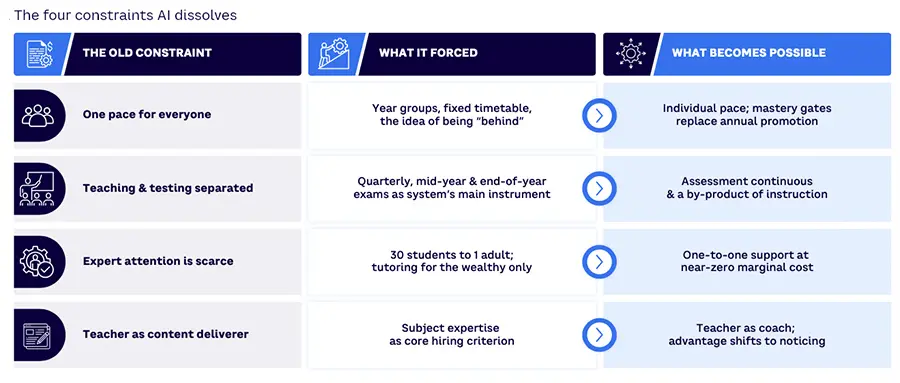
However, other research points to significant risks. In one study, access to AI improved students’ grades by 48%, yet once the technology was withdrawn, students performed 17% worse than peers who had never used it.
“AI has the potential to fundamentally change how students learn, but better grades do not necessarily mean better learning. For GCC education systems, the priority must be to ensure that technology builds genuine knowledge and critical thinking skills,” said Kazimi, Principal at Arthur D. Little.
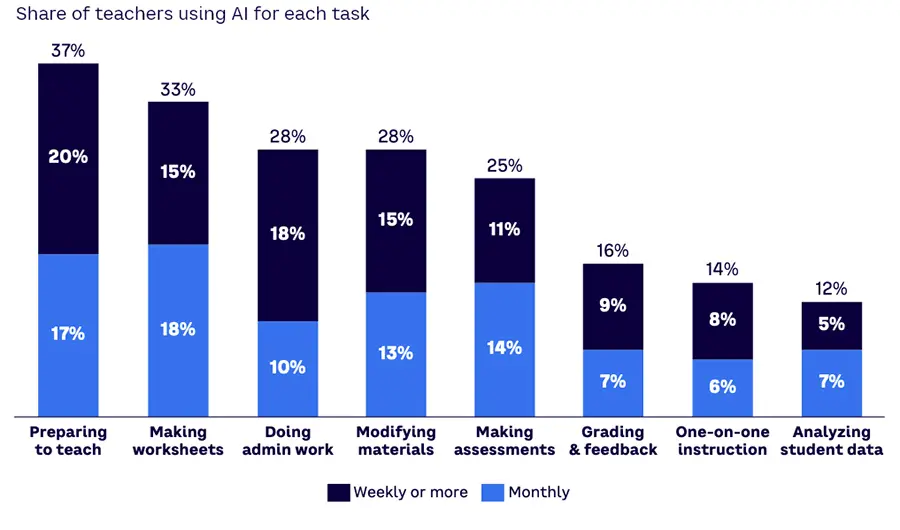
AI also offers opportunities to improve teacher productivity. US teachers using AI at least weekly reported saving an average of 5.9 hours per week, freeing up time that could be spent on personalized instruction, student engagement and feedback. Yet separate research found that 45% of US school educators had received no formal AI training.
An opportunity for the GCC
Across the GCC, governments are increasingly placing AI at the heart of their education and human capital development agendas, recognizing the importance of preparing younger generations for an increasingly technology-driven economy.
The UAE introduced AI as a formal subject in public schools from kindergarten to Grade 12 in the 2025-2026 academic year, covering everything from foundational concepts and algorithms to ethical awareness and real-world applications. Saudi Arabia has meanwhile rolled out AI-related educational initiatives reaching more than six million students.
These developments come as governments are looking to expand education capacity. Dubai’s Education 33 strategy targets at least 100 new private schools by 2033, while Saudi Arabia is targeting 25% private sector participation in education by 2030.
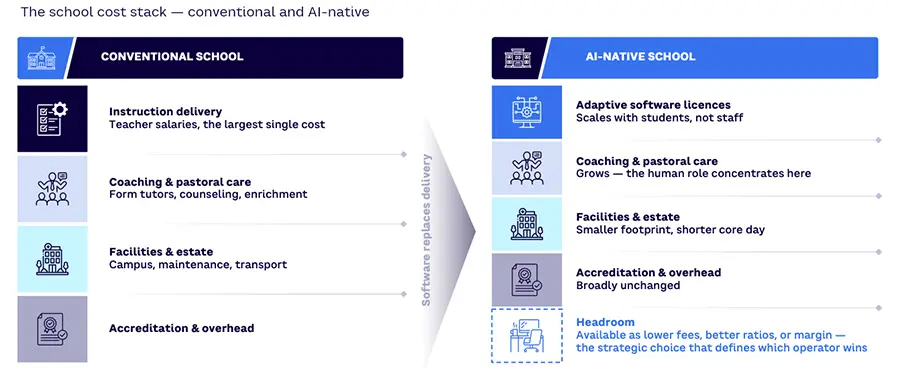
Arthur D. Little argues that the emergence of schools that embrace AI could also reshape the economics of education, with savings from AI-assisted instructional delivery potentially translating into lower tuition fees, improved staffing ratios or higher margins for school operators.
“The GCC has a unique opportunity to move beyond simply digitizing classrooms and become a leader in redesigning education delivery,” said Saf, Partner at Arthur D. Little. “As governments expand school capacity and prioritize educational quality, AI could help unlock more personalized and affordable learning models.”
“However, success will depend on how effectively education systems redesign assessment, prepare teachers and establish the right governance frameworks. The question is no longer whether schools will adopt AI, but how quickly they can adapt their operating models to deliver better outcomes.”
Among its recommendations, Arthur D. Little calls for education systems to reform assessments to measure genuine student mastery, invest in teacher training, and establish clear policies around student data protection and age-appropriate AI use. The strategy consulting firm also highlights that the real opportunity does not lie in “simply bringing AI into the classroom”, but in fundamentally improving how schools operate, teachers teach and students learn.