Embedded finance is reshaping the distribution of SME lending

The next phase of SME finance may not be defined by who manufactures the loan, but by who owns the customer relationship at the moment financing is needed. Experts from Saudi management consultancy Impactors explain why embedded finance is reshaping the SME lending distribution landscape.
For years, embedded finance was largely discussed as a technology story. Banks expose products through APIs. Fintechs connect the infrastructure. Non-financial companies add payments, lending or other financial services into their platforms. That remains true. But a more important shift is happening underneath it.
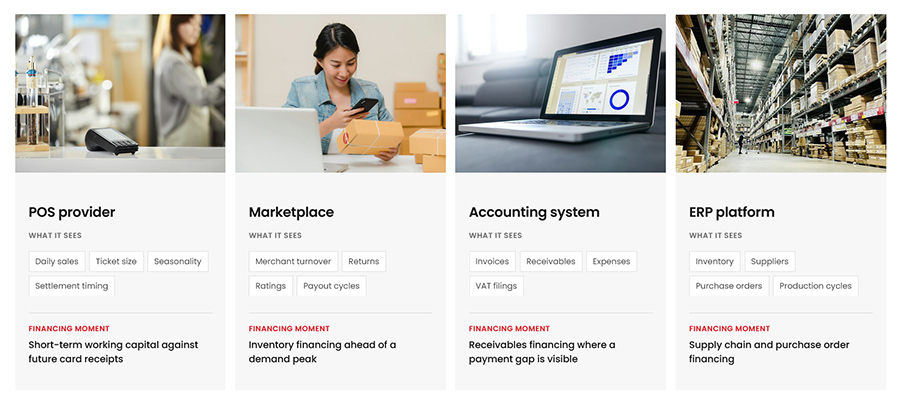
The businesses gaining strategic importance are the platforms already sitting inside the SME’s daily operations: point-of-sale providers, marketplaces, e-commerce platforms, accounting systems, ERPs and other vertical software companies. They are becoming a new financial distribution layer.
For Saudi Arabia, where SME financing is expanding rapidly, that could materially change how businesses access credit.
SME finance market
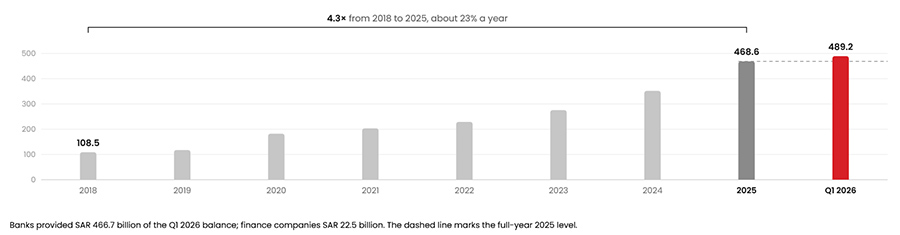
Saudi Arabia has made real progress in expanding SME financing. By the end of 2025, credit facilities extended to micro, small and medium enterprises reached SAR 468.6 billion, a 33% increase on the year before, and by the first quarter of 2026 the balance stood at SAR 489.2 billion. That is significant movement in a market where access to financing has historically been one of the major constraints facing smaller businesses.
Credit provided to Micro, Small and Medium Enterprises (MSMEs) has more than quadrupled since 2018, and the pace has stepped up rather than settled.
Yet the ambition remains considerably larger than the progress. Vision 2030 targets SME lending at 20% of total bank loans. In 2025, the ratio reached 11.3%, up from a 2% baseline. Just over half the distance to the 2030 target has now been covered.
The remaining half, however, represents a harder segment of the market to reach, as many smaller businesses lack the credit history, collateral or financial documentation required to qualify for traditional bank financing.

Embedded finance
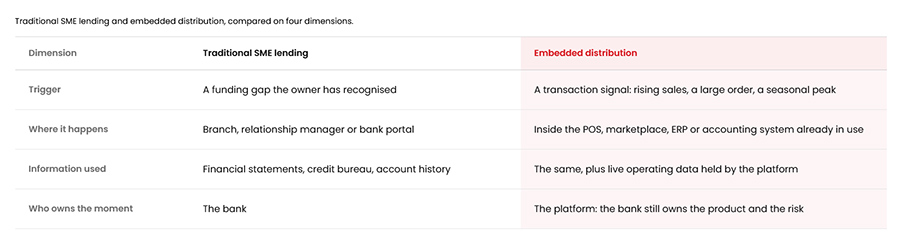
Traditional lending starts with the bank. Embedded finance starts with the business. Consider a small retailer. Traditionally, when the business needs working capital, the owner has to recognise the need, identify a lender, approach the bank, provide information and go through an assessment process. The SME effectively leaves its own workflow and enters the bank’s.
Embedded finance reverses that. Imagine the same merchant operating through a POS platform that already sees transaction volumes, sales trends and seasonality. Instead of the merchant searching for financing, a working capital offer can appear inside the environment the merchant already uses: based on your recent sales, your business may be eligible for SAR 150,000 of working capital.
The financial product has not fundamentally changed. The point of distribution has.
The information gap
The distributor may know something the lender does not. Banks hold strong financial information: account balances, existing liabilities, repayment behaviour, credit history, financial statements. Platforms increasingly hold a different kind of information, what the business is actually doing week to week.
Banks see financial behaviour; platforms see operating behaviour; the combination is what improves reach.
Connected properly, those two views improve how financing is identified, distributed and potentially assessed. It also explains why POS, ERP and marketplace providers are becoming strategically relevant to SME lending. They are not necessarily replacing the lender. They are moving closer to the moment the need becomes visible.
The value chain
As a result of these shifts, the value chain is changing. The emerging model can be viewed through three roles.
1) Manufacturer
Banks and licensed finance companies provide the balance sheet, underwriting, regulated product and risk capabilities.
2) Enabler
Fintech infrastructure connects financial institutions to external ecosystems through APIs, data connectivity and orchestration.
3) Distributor
POS platforms, marketplaces, ERP providers and other digital businesses own the customer interaction.
Historically, financial institutions controlled much of this value chain themselves. Embedded finance breaks it apart. And the distributor can become particularly valuable because it controls when, where and in what context the financial product is presented.
An opportunity for banks, not only for fintechs
The implication is not that platforms will replace banks. Banks hold capabilities that are difficult to replicate: funding, a regulated balance sheet, underwriting, compliance infrastructure and risk management. But a bank does not need to own every customer interface.
Instead of asking how to bring more SMEs into our channels, the question becomes: which channels already have the SMEs we want to finance? A bank could work with a POS provider serving restaurants, an ERP platform serving wholesalers, a marketplace serving online merchants, or a property platform serving landlords and contractors. The platform provides distribution and commercial context; the bank provides the regulated product.
Not every embedded finance proposition will work. Placing a loan button inside an application is not enough. The strongest propositions use the distributor’s understanding of the business to make the offer contextual, and the difference is easy to hear.
Key takeaway
Embedded finance should no longer be read only as an API strategy. It is a distribution strategy. Designed well, it is also a proactive one: financing offered at the moment the business’s own data shows the need, rather than a product waiting for an application.
As Saudi Arabia works toward its 2030 SME financing ambition, the institutions that get this right may not be those with the best lending product, they may be the ones that put that product where the SME already does business.