How Gulf governments can turn agentic AI ambitions into results


Gulf governments are aiming to lead the way in agentic AI, launching initiatives to deploy AI agents alongside their human workforce. Saad Hamam, Managing Director of Horváth in the Middle East, explores the governance, workforce and measurement decisions that will determine whether these ambitions translate into tangible results.
The UAE has set a two-year target for AI agents, and Saudi Arabia has built the foundations. The questions that will shape the value are authority, people, and measurement, and they are best settled early.
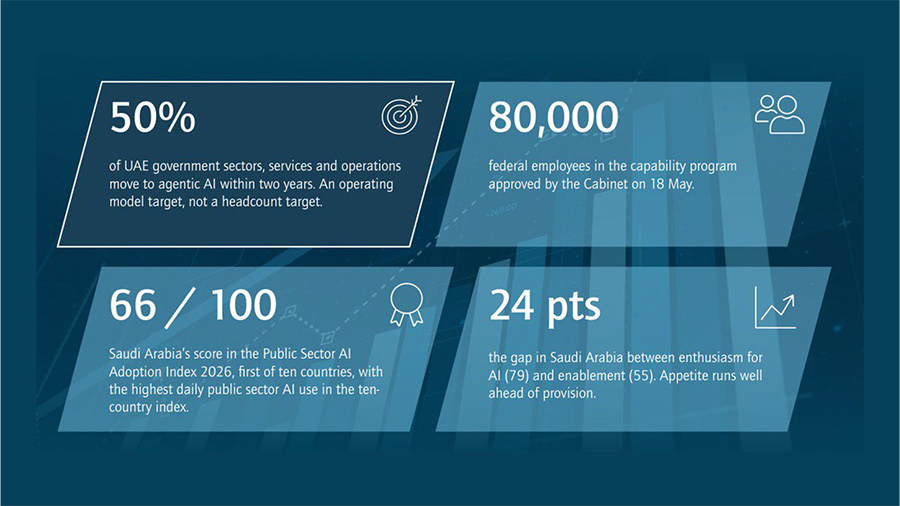
In April 2026 the UAE committed to moving half of its government sectors, services and operations to agentic AI within two years. It is one of the most ambitious public sector technology commitments anywhere, and the region is moving at a pace few governments elsewhere can match.
An agent is different from the AI assistants most organizations already use. It can be given permission to act: to approve a case, update a record or issue a communication. That changes the questions leaders need to answer. The quality of the model matters less than the authority it is given, the roles of the people around it, and the way progress is counted.
A target for how work is done
The UAE figure is easy to read as a workforce target. It is not. The commitment is to move 50% of government sectors, services and operations, and the framework behind it names the principle it rests on: people come first. On 18 May the Cabinet approved a capability program for 80,000 federal employees across five occupational categories, alongside roles for every ministry and the first services for conversion.
The pace since has been striking. Within weeks the first four federal agents were launched, for procurement, tax auditing, customer happiness and technical support. By September an AI and Data Authority had been established and a second phase was under way.
Two routes to the same destination
Saudi Arabia has taken a different route. Since 2019 it has built the layer underneath: SDAIA as the national data and AI authority, an AI Adoption Framework with AI offices in 23 government entities, a National AI Index that measures entity readiness, a national AI risk framework, and more than one million citizens certified through SAMAI.
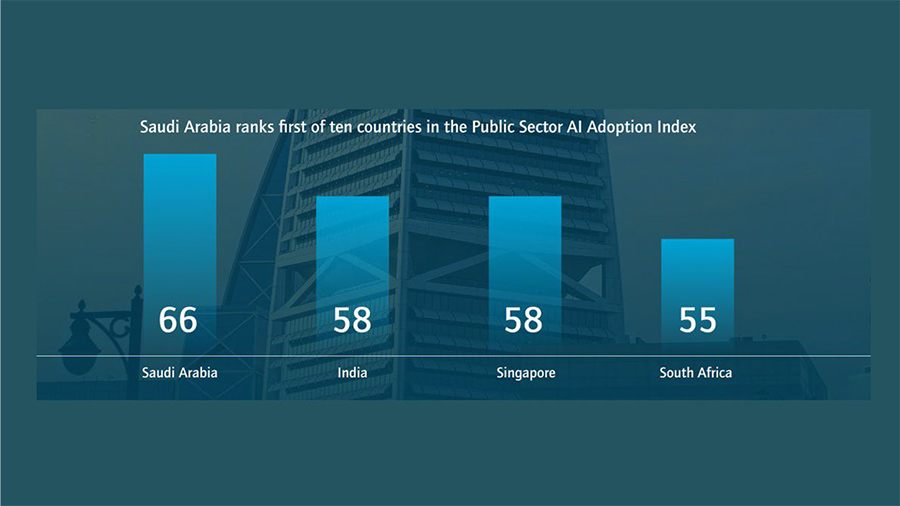
The results are visible. In the Public Sector AI Adoption Index 2026, Saudi Arabia ranked first of ten countries, and around two thirds of its public servants use AI at work every day.
Each route is strongest where the other is still building. A dated commitment drives decisions; a measured foundation helps those decisions deliver. The UAE and Saudi Arabia each have something the other can draw on.
Deciding what an agent may decide
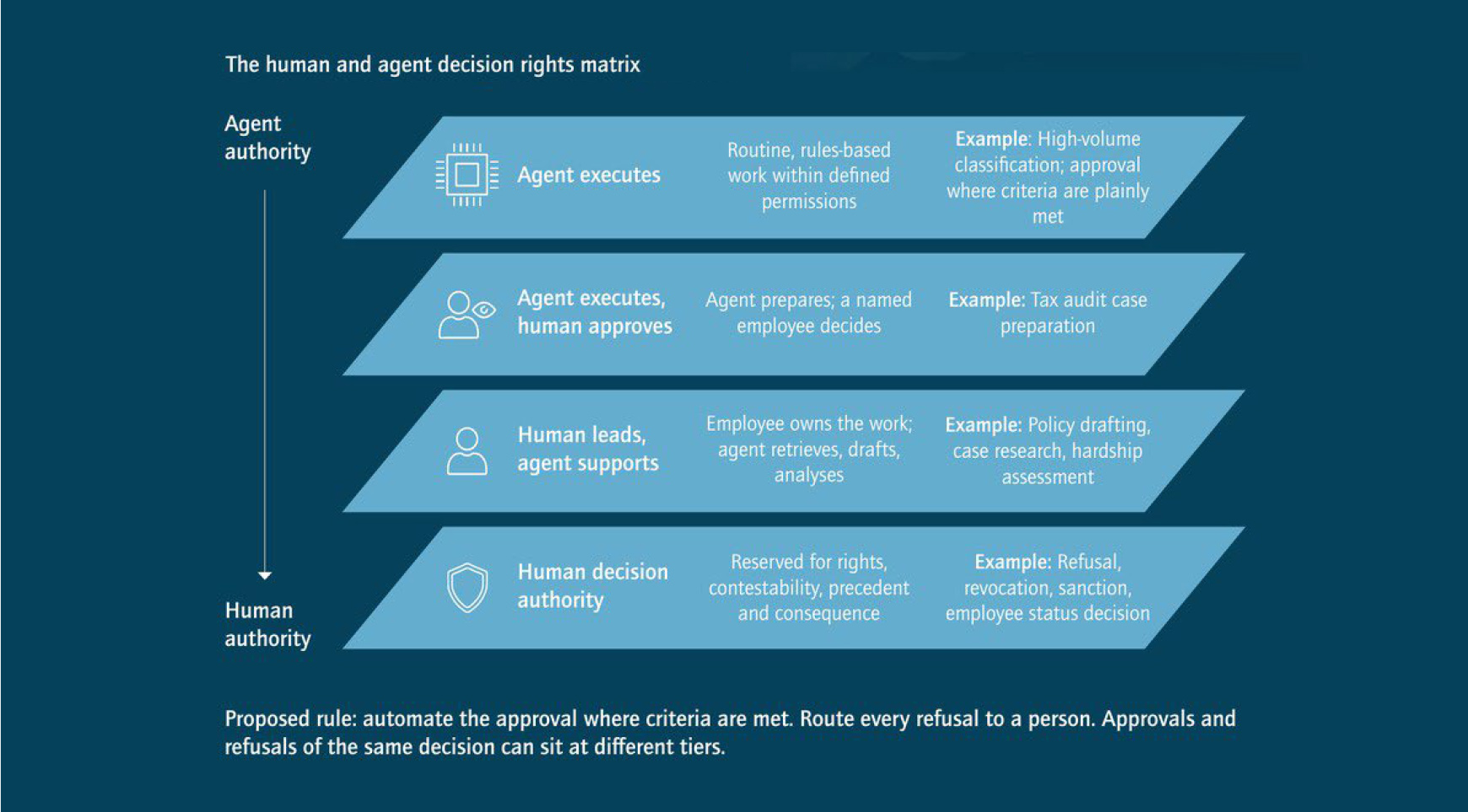
The first question every entity faces is where to draw the line between agent and person. At Horvath, our recommendation is not to draw this line by risk score. We would draw it with two questions. Does the decision create, remove or refuse a right or an entitlement belonging to a person? And is it contestable?
If a citizen can appeal a decision, a person has to have made it. That leads to a simple proposed rule: automate the approval where the criteria are plainly met, and route every refusal to a person. In most services the great majority of cases are straightforward approvals, so the rule keeps most of the efficiency while keeping accountability where citizens expect to find it.
Settling this early is what lets a program scale. When the authority to act is designed in from the start, written into the delegation of authority alongside the technology, a successful pilot moves straight into production. When it is left until the end, a pilot that works can wait months for a legal answer. In our experience the model is rarely what holds a program back; the delegation of authority usually is.
Preparing people for the week after launch
The question government clients raise first is what agentic AI means for their people, and the most useful answer is not a headcount. It is what those people will be doing in the week after an agent goes live.
That depends on HR moving before conversion rather than after it. Workforce plans built on positions need to be rebuilt around activities. Job descriptions need to change alongside the service. Performance measures need to reward the behavior the program requires. And four roles that most job catalogues do not yet define will be needed in every entity that converts at scale: the agent supervisor, the exception handler, the process and rules owner, and AI assurance.
Those roles are also an opportunity. They are skilled, clearly defined and central to how government will work, which makes them a natural entry point for national graduates.
Measuring the work that changes
Targets shape behavior, and the way a target is counted shapes the target. If progress is measured as a share of services, the easiest services convert first while the few that carry most of the workload wait their turn. A program could convert 90% of its services and reach only 10% of the volume.
Count the share of real work converted, not the number of services listed. The answer is straightforward: count the share of real work converted, and record a starting point for every service before it enters the program, covering time, cost, quality, employee effort and service outcome. That is what allows a government to show citizens, and itself, exactly what the program has achieved.
Seven decisions to settle early
Government leaders in the UAE and Saudi Arabia seeking to adopt agentic AI should consider seven actions, none of which requires a platform decision first. Write the decision inventory for one high volume service. Record the starting point for every service entering the program. Set decision rights in the design rather than at sign off. Change the workforce plan from positions to activities.
Further, build capability role by role, and test supervision rather than attendance. Treat data ownership as a governance decision. And redesign the target operating model around the new allocation of work.
Key takeaway
Two years is long enough to change how government works. The governments with the most to show at the end of it will be the ones that settled three questions early: which decisions an agent may take, what the people who did that work will do next, and what counts as progress.
Across the Gulf the agentic AI ambition is already in place. The next two years are about making it deliver.