Where transformation programmes in the Middle East actually stall

Most transformation programmes in the Middle East are not lost at the point of decision. According to Horváth leaders Saad Hamam and Patrick Braunschweig, they are lost in the long middle – after approval has been secured and before outcomes are delivered. The winners in transformation are those that build the discipline to turn ambition into execution.
Across more than a decade of transformation work in this region, as well as in-depth research on the matter, we have found that the programmes which did not reach their outcomes almost never failed at the point of approval. They were approved with conviction, resourced properly and announced to organisations that believed in them. They stalled later, quietly, somewhere in the middle.
That is not where governance is looking. Steering committees, stage gates and monthly reviews are built to detect a programme that has stopped moving. Very few are built to detect one moving confidently in a direction nobody owns.
Five patterns, and the signal that precedes each one
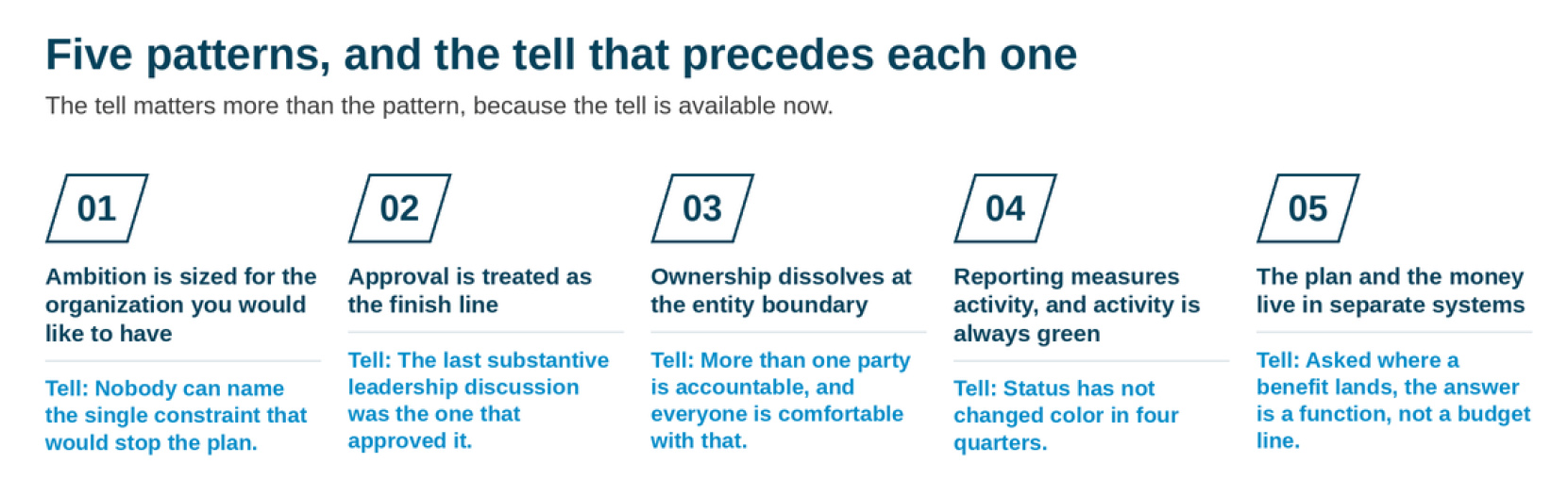
Execution drift is not random. It follows a limited number of recurring patterns, and each announces itself through something a leadership team can observe long before delivery is visibly at risk. The signal matters more than the pattern, because the signal is available now.
Ambition is sized for the organisation you would like to have. Targets are set against the capability an organisation intends to build rather than the one it holds today. The plan is not wrong, it is simply not yet deliverable by the people who have to deliver it. The signal: nobody in the approval meeting can name the single constraint that would stop the plan.
Approval is treated as the finish line. The strategy is signed, the room agrees, and senior attention moves to the next decision, at precisely the moment the work becomes hardest. The signal: the last substantive leadership discussion of the programme was the one that approved it.
Ownership dissolves at the entity boundary. Within a single organisation, accountability usually holds. Across two or three it disperses. This matters disproportionately here, where programmes are routinely delivered through holding structures, related entities, joint ventures and special purpose vehicles, and where national strategies set targets no single participant can reach alone. The signal: more than one party is accountable, and everyone is comfortable with that arrangement.
Reporting measures activity rather than outcomes. Workshops held, documents issued, milestones closed. All true, all reported, and none of it evidence that anything has changed. The signal: status has not changed colour in four quarters, and nobody finds that unusual.
The plan and the money sit in separate systems. Strategy sits with the transformation office, the budget sits with finance, and the two are reconciled annually rather than continuously. The signal: asked where a benefit lands, the answer is a function rather than a budget line.
The most visible failure and the most expensive one are not the same
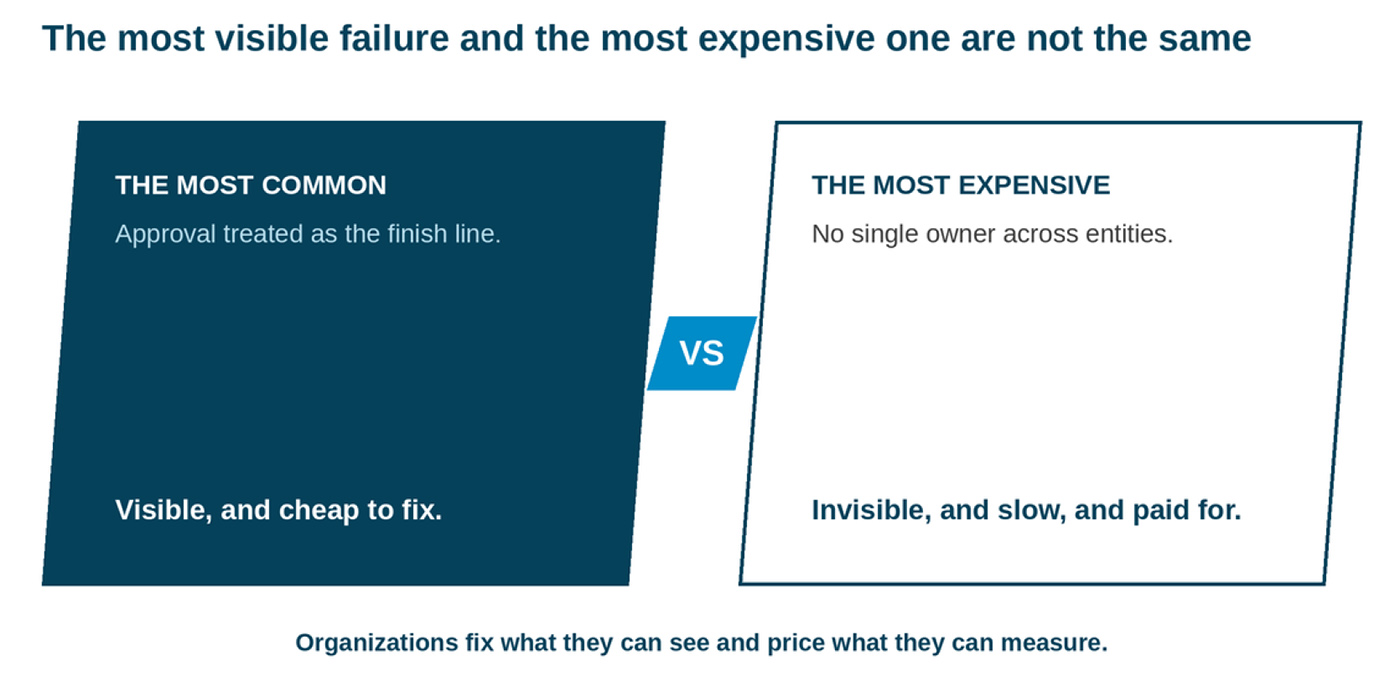
Of those five patterns, the one that occurs most often and the one that costs most are not the same pattern, and the distance between them is the most useful thing a board can understand about its own delivery.
The most common is treating approval as the finish line. It occurs in every sector and at every scale, and it is also the cheapest to correct: a governance redesign and a ninety day plan, paid for in senior attention rather than committed capital. The improvement is visible almost immediately, which is part of the reason it gets fixed.
The most expensive is the absence of a single accountable owner on cross entity initiatives that commit capital. It does not announce itself. Nothing visibly goes wrong. Work sits between organisations while capital continues to be committed on the assumption that it is moving. By the time it surfaces, the money is spent and the sequencing cannot be recovered.
Organisations fix what they can see and price what they can measure. Almost every governance instrument a large organisation owns is designed to catch the first failure, and very few are designed to catch the second.
Six instruments
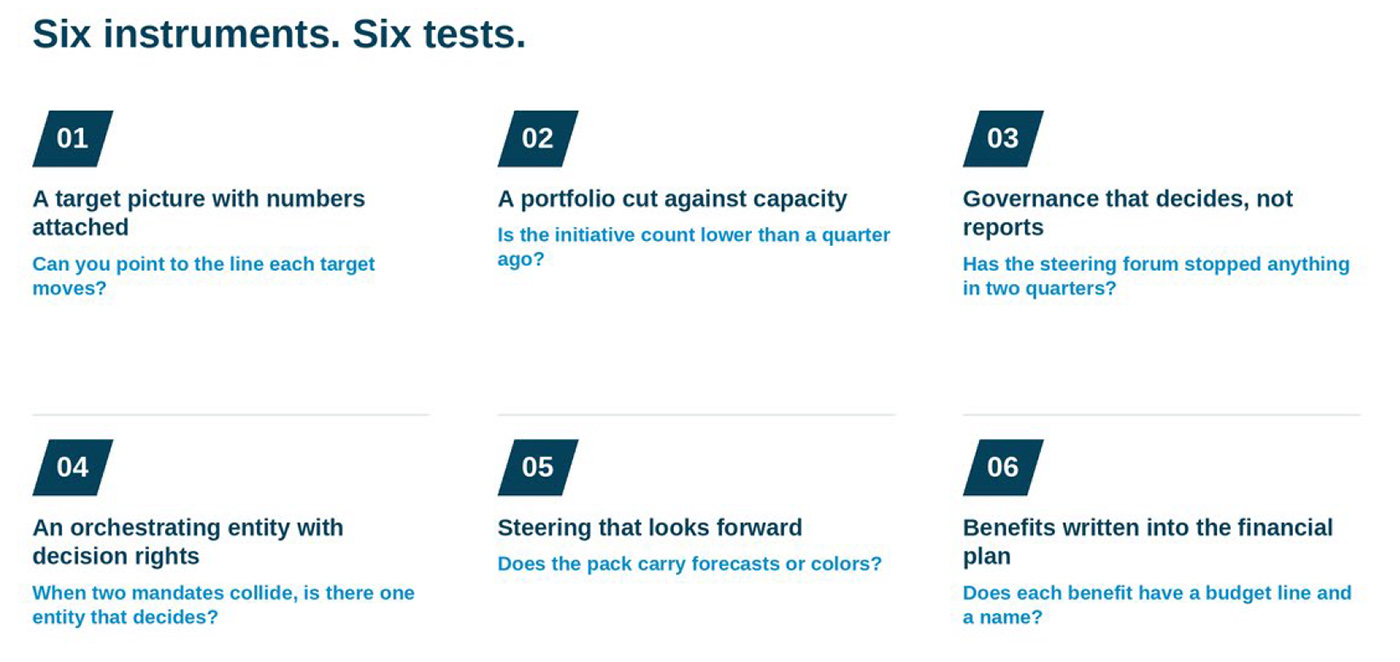
The correction is a set of mechanics rather than a philosophy. None of these instruments requires a new strategy, and each carries a test that can be applied to an existing portfolio without a diagnostic.
A target picture with numbers attached, before anyone mobilises. Every agreed target traced through to the line it is supposed to move, whether cost base, revenue or margin. A target that cannot be found in the numbers is an intention. The test: can you point to the line each target moves?
A portfolio cut against capacity rather than ambition. Most organisations run more initiatives than they have people to run, and the first full count is usually higher than expected. Capacity spread across forty initiatives lands none of them. The test: is the initiative count lower than it was a quarter ago?
Governance redesigned to decide rather than to report. A steering body that cannot stop an initiative, reallocate capacity or move money is a reporting forum, whatever it is called. Decision rights and escalation paths have to be written down and tested early against a live decision. The test: has the steering forum stopped anything in two quarters?
An orchestrating entity with real decision rights. Where delivery depends on participants who each hold their own mandate, funding cycle and board, ownership of the whole has to be placed somewhere rather than shared. One entity must carry the standing to convene, arbitrate and hold others to commitments. The test: when two mandates collide, is there one entity that decides, and do the participants accept that it does?
Steering that looks forward. Status colours describe what has already happened. Forecasts describe what is about to happen, and only one of those can be acted upon. The test: does the pack carry forecasts or colours?
Benefits written into the financial plan. If a saving does not appear in a budget line with an owner’s name against it, it will not be delivered and nobody will notice. This is what connects a transformation office to a finance function. The test: does each benefit have a budget line and a name?
What ninety days should look like
Leadership teams reasonably ask what changes once execution discipline is installed, and how quickly. In our experience three months is enough to see it, and the sequence is consistent enough to plan against.
In the first month, one consolidated list of everything in flight appears with an honest count against it, and for most leadership teams it is the first time the whole portfolio has been visible in one place. A meaningful share is stopped, merged or deferred. In the second, baselines exist, forecasts begin to replace status colours, and the first honest red appears. How the leadership team responds to that first red determines whether any of the rest survives.
By the third, the first benefits are traceable to budget lines with names against them, and capacity conflicts are resolved explicitly rather than by whoever escalates loudest.
Three questions for executives
Any leadership team can test its own position without external help. Who owns this outcome, and were they in the room when we agreed it? Where does this benefit appear in the financial plan, and against whose budget? What did our steering meeting decide last month, and can we point to it?
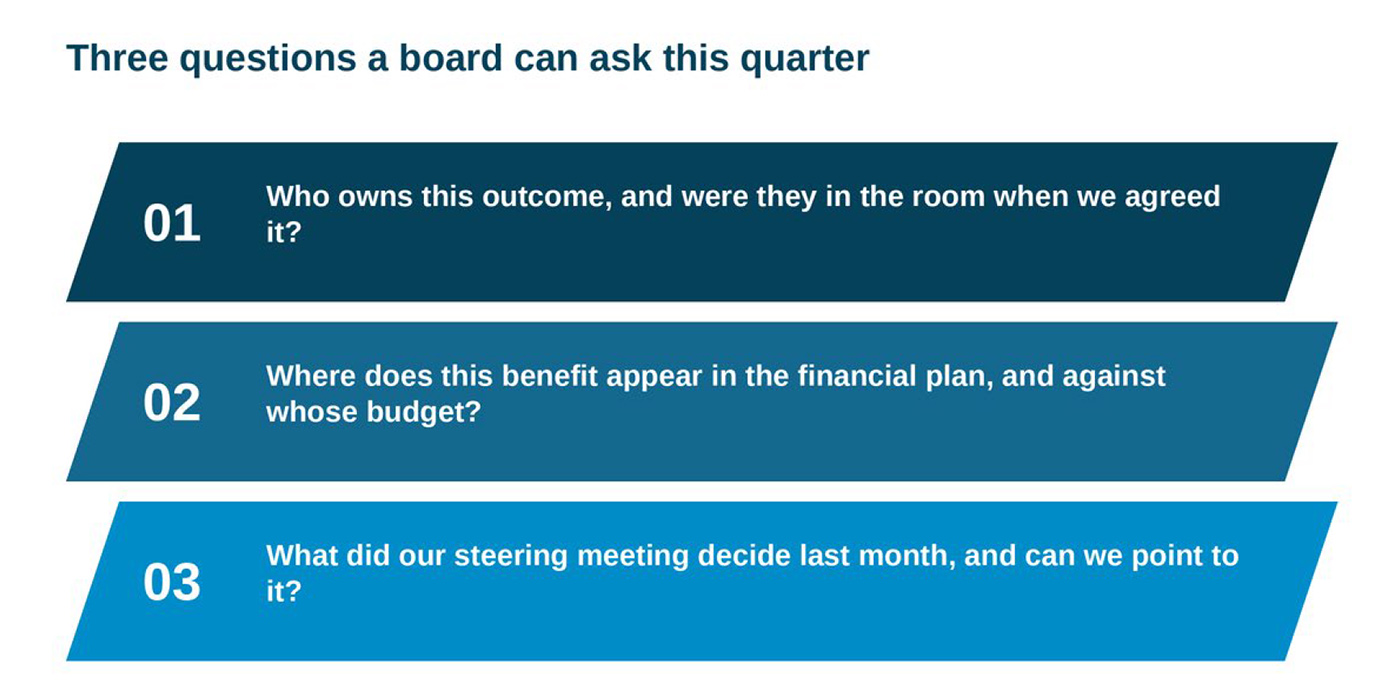
The third is the most revealing. If it is difficult to answer, the mechanism in place is reporting, and the organisation is carrying the cost of governance without the benefit of it.
Build the execution discipline
This region has never had a shortage of ambition. What it is building now is the discipline to deliver it, which is a harder thing and a more valuable one. The programmes that reach their outcomes are not the ones with the boldest plans or the largest budgets. They are the ones where someone could always answer three things: who owns this, what does it change, and how will we know.