‘Middle East the most cost-competitive region for new data centres’

The Middle East is one of the most cost-competitive regions globally for the build of new data centres, according to the latest Data Centre Construction Cost Index from Turner & Townsend.
Now in its 10th edition, the annual global draws on the deep insights of Turner & Townsend in the data centres market, supplemented by a survey of over 400 experts working across the industry. According to its own records, the programme management company has to date completed over 500 projects in the domain in over 50 countries.
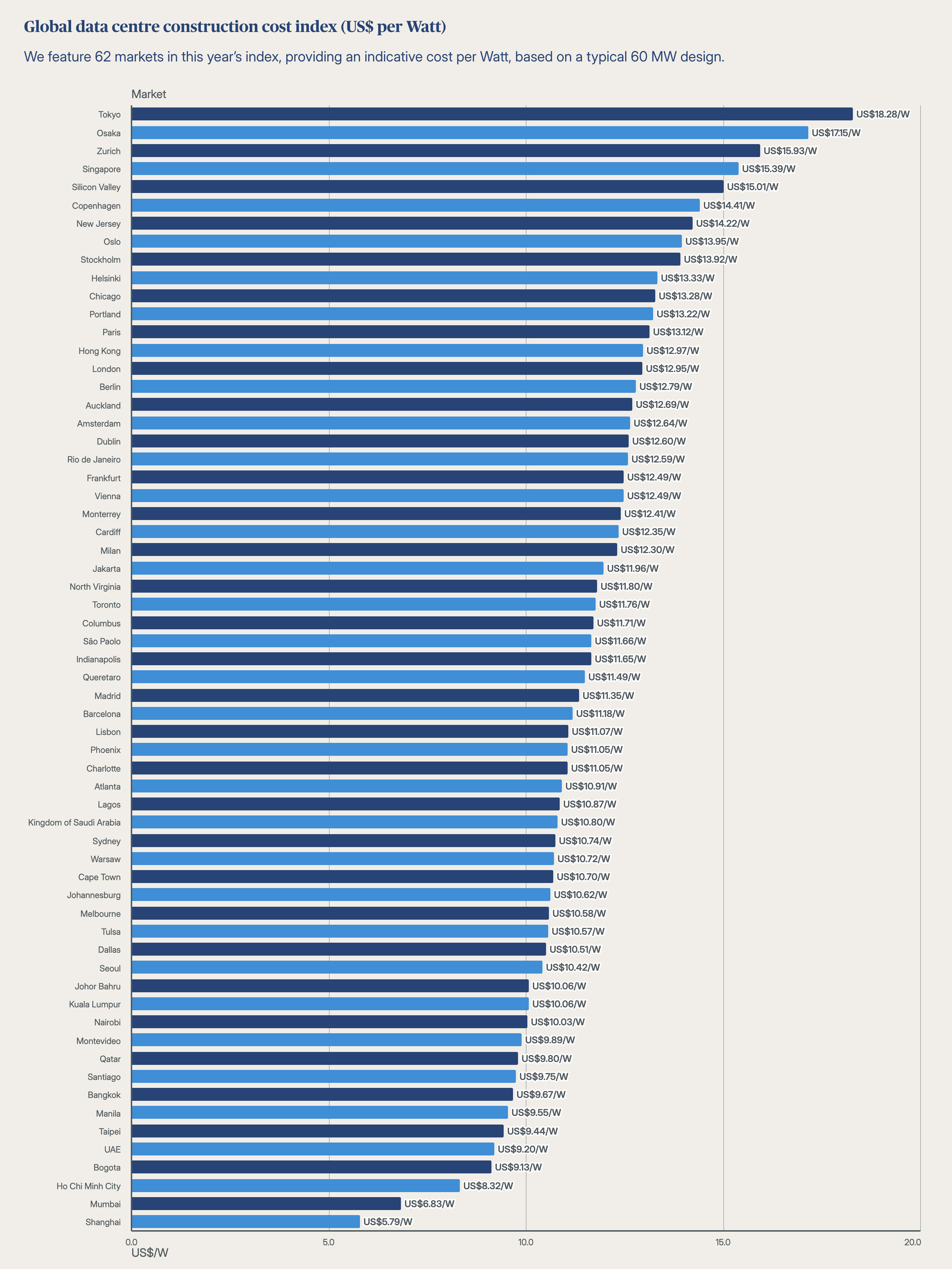
The research reveals that two Japanese cities – Tokyo and Osaka – are the most expensive location globally for data centre construction, at $18 per Watt and $17 per Watt respectively. Zurich ranks third with an average of $16 per Watt.
In comparison, key locations in the UAE, Qatar and Saudi Arabia all have an average construction cost of under $11 per Watt: Saudi Arabia at $10.80, Qatar at $9.80 and the UAE at $9.20. With a region-wide average of $9.93 per Watt, the Middle East is currently the least expensive area globally for data centre construction, notably more affordable location than Europe ($12.76), Asia ($12.10) and North America ($12.06).
“The Middle East stands to benefit from its relatively low cost of construction and energy, as well as strong government backing for AI infrastructure. Saudi Arabia’s HUMAIN initiative and the UAE’s continued investment in AI and hyperscale data centre development through G42 and Khazna are transforming the region’s computing capacity and positioning it as a globally competitive AI hub,” said Alan Coary, Director and Data Centre lead for the Middle East at Turner & Townsend.
Rising costs
Data centre construction costs continued to rise globally in 2026, as surging demand for AI computing power and large-scale data centre projects outpaced the supply of powered land and skilled labour to deliver them.
“Despite some stabilisation in cost inflation in 2026, structurally higher construction costs and risk are increasingly priced into contracting, while a deepening skills shortage is putting pressure on labour costs,” said Coary.
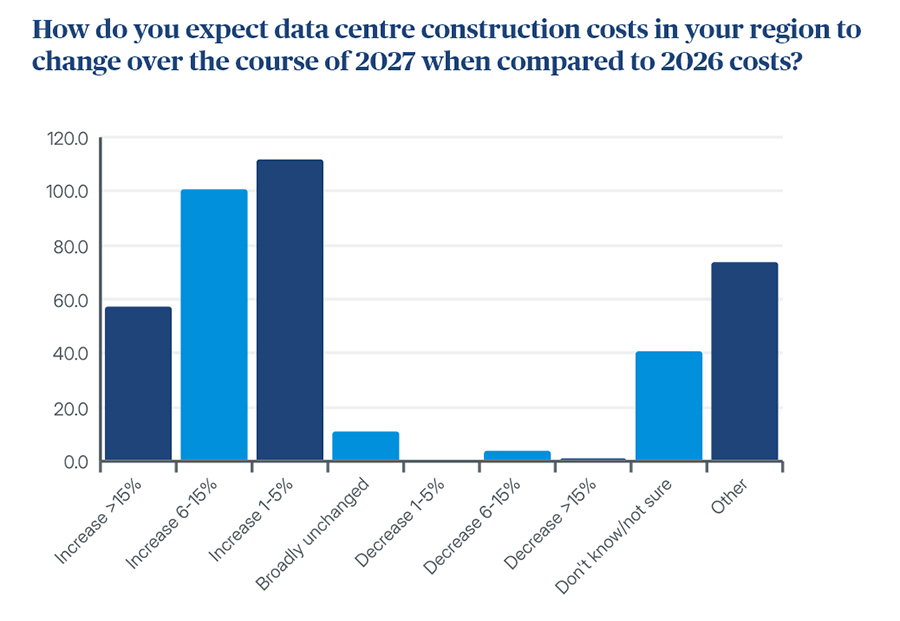
The survey found that the rising costs of data centre construction are increasingly driven by the growing scale of the builds, particularly for AI facilities, which require alternative delivery approaches, technical specialists and new risk-balanced models to overcome strained capacity and accelerate schedules. Over half of the respondents anticipate a majority (>50%) of their 2027 projects will be data centres to support AI workloads.
Paul Barry, the lead author of the Data Centre Construction Cost Index, said: “AI’s exponential demand for computing power, combined with cloud adoption and the growing importance of data and sovereign capacity, is driving data centre investment and development at unprecedented scale, reshaping the construction landscape.”
“However, rising material and labour costs continue to create challenges globally, while access to power, specialist equipment and skills continue to create bottlenecks. Data centres are also subject to increasing scrutiny, with political and community consent essential to delivery.”
The outlook
Looking ahead, Turner & Townsend said the industry will need to rise to the challenge of meeting the rapidly growing demand for computing power in an increasingly digital world.
“Success will ultimately depend on the industry’s ability to think beyond the boundaries of a single project. Power, water, supply chains, labour, planning, sustainability and data sovereignty are becoming interconnected challenges that require coordinated solutions,” Barry said.